

Hirundo rustica
Range
They spend the summer breeding in Alaska and across Canada, throughout most of the U.S., except parts of southwestern deserts. They are also found down into central Mexico, Central and South America, Eurasia and North Africa.
Habitat
They live in places with open areas like farms, fields and along roadsides and even in cities. The area where they live needs mud for nest building.
Body Traits
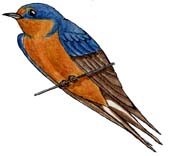
They have long, pointed wings, a metallic blue head, back and tail and a rusty colored chest and belly. They have a long, forked tail.
Habits
They are strong fliers and will swoop low over water and grassy areas to snatch up insects. They may perch on wires and join with other barn swalllows to forage. Their acrobatics in flight, with sharp turns and dives is impressive to watch.
Diet
They catch and eat insects in mid-flight.
Reproduction
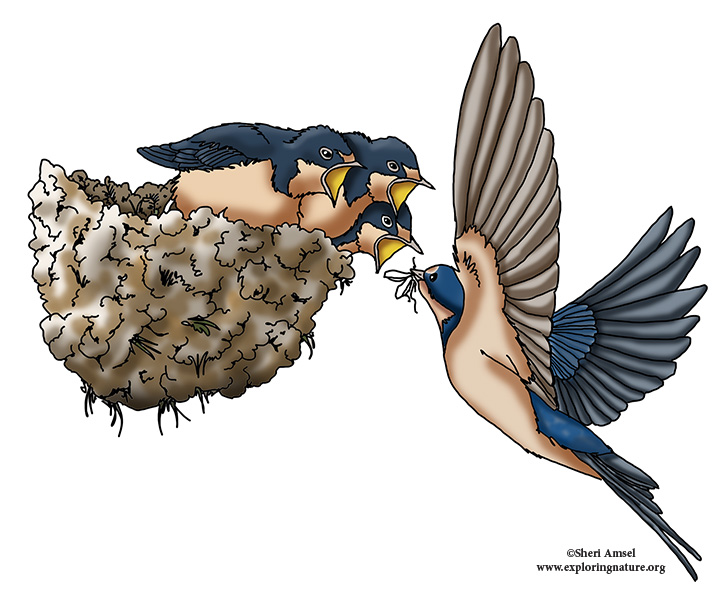
Nesting pairs build an open cup nest of mud and grass up under an overhang or on a ledge or shelf. They line it with grass stems and feathers. Nests are often found under porches, in barns, under bridges, etc. They do nest in boxes. Females lay 3 – 7 white eggs with dark spots. Both parents will sit on the eggs (incubate). Once the chicks hatch, the parents take turns bringing them insects to eat. When a parent approaches the chicks, they will raise their heads, open their mouths and peep loudly.

Classification
Kingdom: Animalia
Phylum: Chordata
Subphylum: Vertebrata
Class: Aves
Order: Passeriformes
Family: Hirundinidae
Genus: Hirundo
Species: H. rustica