

Plant Science
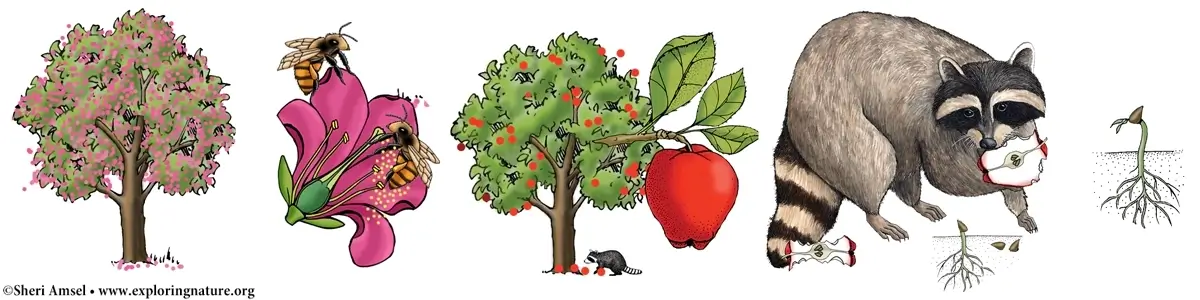
About Plants (Introduction)
Carnivorous Plants
Energy Flow Between Organisms – Plants – Reading
Flowering Plants (Angiosperms)
Growth and Development of Organisms – Plants – Reading
Mosses (Bryophytes)
Photosynthesis
Photosynthesis (Grade 9-12)
Photosynthesis & Cellular Respiration
Photosynthesis Simplified (Elementary Levels)
Plant Adaptations for Pollination & Seed Dispersal
Plant Cell Organelles – Functions
Plant Reproduction
Plant Reproduction Illustrated – Growth and Development of Organisms (NGSS 6-8 Grade)
Plant Structure – The Parts of a Plant and Flower
Pollination Adaptations – Birdsfoot Trefoil
Vascular Plants: Trees, Grass, Ferns, Flowering Plants
What Plants Need – Read Aloud (K-2)
Related Links
Related Information:
Forest Succession
Plant Cell Organelles – Functions
Plants and Animals Need Each Other in the Amazon Rainforest – Reading
Related Activity:
A Look at Plant Cell Organelles – Coloring
Energy Flow in an Ecosystem – Biomass Activity
Garden Vegetables Coloring Pages (10)
Graphic Organizer – Plant Structures
Graphic Organizer – Plant Structures and Functions
Learning About Plants – Scavenger Hunt
Learning About Plants – Make a Terrarium
Make Your Own Plant Press
Name the Plant Cell Organelles
Onion Skin Cells – Investigation
Parts of a Plant – Model Making Activity
Parts of the Plant Identified in Popular Media
Photosynthesis – A Simple Experiment
Photosynthesis Investigation
Photosynthesis Coloring Page
Photosynthesis Poster – 2D Model for K-2nd Grade
Photosynthesis Poster – 2D Model for 3-5th Grade
Photosynthesis Poster – 2D Model for 6-8th Grade
Plant Cell Coloring Page
Plant Life Cycle Activity (K-3)
Plant Party
Plant Structures: Foldable Activity
Pollination or Seed Spreading in the Amazon Rainforest – Matching
Plants Depend on Animals in the Rainforest – An Illustrated Report
Seed Dispersal Experiment – Field Study
Seed Dispersal Adaptation Comic
Seed Search Activity – Create a Forest Floor Collage
Tree Activities
What Plants Need Coloring Page
Where Does it Come From? The Importance of Plants (Young Students)
What Plants Need – Matching (Color)
What Plants Need – Matching
What Plants Need – Poster
What Plants Need to Grow – Poster
What Plants Need Coloring Page
What Plants Need to Grow – Investigation (Kindergarten NGSS)
What Plants Need to Grow – Investigation (Grade 5 NGSS)
Related Visual Aids:
Forest Sucession Mini-Poster
Life Cycles of an Angiosperm
Life Cycle of a Gymnosperm
Plant Cell – Color Diagram
Parts of a Tree Mini-Poster (Color)
Plants Cell Mini-Poster
What Plants Need – Poster
Related Testing and Assessment:
Deciduous Tree Identification by the Leaves
Flower Parts Labeling Page
Forest Succession Activity
Label the Parts of a Tree
Label the Plant and Animal Cells
Label the Parts of the Flower (Elementary)
Label the Parts of the Flower (In Color for Elementary)
Label the Parts of the Plant
Match the Tree (Leaf) to its Fruit
Plant Reproduction – Multiple Choice Test
Parts of a Plant – Matching
Plant Structure – Multiple Choice Test
Plants – The Important Jobs They Do – Multiple Choice
Seed Dispersal Adaptation – Authentic Performance
Seed Dispersal Matching
Tests on Plants
Tree Identification by Leaves – Fill in the Blank
Wildflower Bloom Shape Labeling Page
Related Movies and Movie Activity Sheets:
Fall Colors – Green Chlorophyll and Photosynthesis
Fern Identification
LS1.C Organization for matter and energy flow in organisms
K-2 Animals obtain food they need from plants or other animals. Plants need water and light.
3-5 Food provides animals with the materials and energy they need for body repair, growth, warmth, and motion. Plants acquire material for growth chiefly from air, water, and process matter and obtain energy from sunlight, which is used to maintain conditions necessary for survival.
6-8 Plants use the energy from light to make sugars through photosynthesis. Within individual organisms, food is broken down through a series of chemical reactions that rearrange molecules and release energy.
LS2.A Interdependent relationships in ecosystems
K-2 Plants depend on water and light to grow, and also depend on animals for pollination or to move their seeds around.
3-5 The food of almost any animal can be traced back to plants. Organisms are related in food webs in which some animals eat plants for food and other animals eat the animals that eat plants, while decomposers restore some materials back to the soil.
6-8 Organisms and populations are dependent on their environmental interactions both with other living things and with nonliving factors, any of which can limit their growth. Competitive, predatory, and mutually beneficial interactions vary across ecosystems but the patterns are shared.
LS2.B Cycles of matter and energy transfer in ecosystems
K-2 [Content found in LS1.C and ESS3.A]
3-5 Matter cycles between the air and soil and among organisms as they live and die.
6-8 The atoms that make up the organisms in an ecosystem are cycled repeatedly between the living and nonliving parts of the ecosystem. Food webs model how matter and energy are transferred among producers, consumers, and decomposers as the three groups interact within an ecosystem.
9-12 Photosynthesis and cellular respiration provide most of the energy for life processes. Only a fraction of matter consumed at the lower level of a food web is transferred up, resulting in fewer organisms at higher levels. At each link in an ecosystem elements are combined in different ways and matter and energy are conserved. Photosynthesis and cellular respiration are key components of the global carbon cycle.