

Parus atricapillus
Range
They are found all across North America from Southern Canada south to the middle United States.Habitat
They live in mixed forests, open woodlands, and wetlands to suburban areas.Body Traits
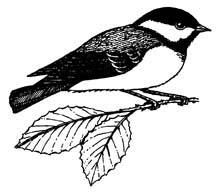
They have a black cap and throat with white cheeks, a gray back, wings and tail and a white belly.Habits
They are very common at feeders all winter. They have a chica-dee-dee-dee call. They form flocks in winter.Diet
They eat insects and seeds.Reproduction
They stay with one mate (monogamous) their whole lives. They nest in a tree hole. The female builds a nest inside made of moss and soft hairs. The female lays about 6 eggs and warms them (incubates) for almost 2 weeks. The male feeds the female while she nests.
Classification
- Kingdom: Animalia
- Phylum: Chordata
- Subphylum: Vetebrata
- Class: Aves
- Order: Passeriformes
- Family: Paridae
- Genus: Parus
- Species: P. atricapillus