


The Mammals (Class Mammalia) includes everything from mice to elephants, bats to whales and, of course, man. The amazing diversity of mammals is what has allowed them to live in any habitat from desert to arctic to the deep ocean. They live in trees, they live on the ground, they live underground, and in caves. Some are active during the day (diurnal), while some are active at night (nocturnal) and some are just active at dawn and dusk (crepuscular). They live alone (solitary) or in great herds (gregarious). They mate for life (monogamous) or form harems (polygamous). They eat meat (carnivores), they eat plants (herbivores) and they eat both (omnivores). They fill every niche imaginable.
Mammals come in all shapes and sizes from the tiny pygmy shrew, weighing 1/10 of an ounce (2.8 grams), to the blue whale, weighing more than 300,000 pounds! They have a huge variation in life span from a small rodent living one year to an elephant living 70 years. Generally, the bigger the mammal, the longer the life span, except for bats, which are as small as rodents, but can live for up to 20 years.
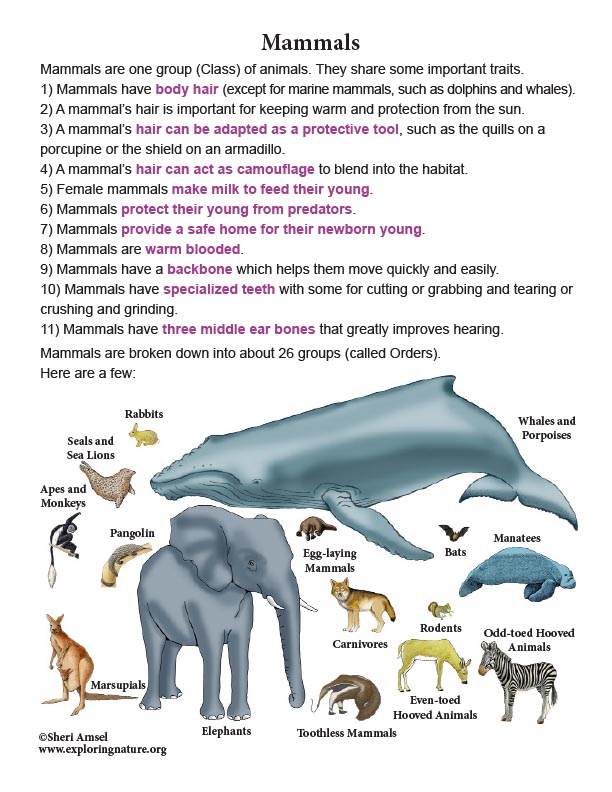
Though huge variation exists in mammals, there are a few physical traits that unite them.
1) Mammals are covered with body hair (or fur) with the exception of marine mammals, like dolphins and whales. They have traded the benefits of body hair for better aerodynamics while traveling in water (though they may have a few bristly hairs around their faces). Hair is important for keeping mammals warm in cold climates, protecting them from sunburn and scratches, and used to warn off others, like when a dog raises the hair on its neck. Sometimes hair is adapted as a protective tool like the spines on a porcupine or the shield on an armadillo or pangolin. Hairs can be used to feel for things, like the whiskers on a cat or sea lion or act as camouflage to blend into the mammal’s habitat.
2) Mammals have 3 middle ear bones called the malleus (hammer), incus (anvil), and stapes (stirrup). They greatly improve a mammal’s hearing, which allows a better ability to communicate. Specifically, when sound waves hit the eardrum, these small bones transmit the vibrations from the eardrum (tympanic membrane) to the inner ear.
3) Female mammals have mammary glands that make milk to nourish their young. The milk is full of fat and protein that helps young grow and develop, giving them a good start toward surviving to adulthood.
4) Mothers (and sometimes fathers) will protect young from predators and often live with them even after they are done nursing to allow them to learn how to hunt, survive predation or be in a social group.
Some other traits of mammals:
5) Mammals have a backbone (vertebrates) with great leg mobility, making them an agile group of animals.
6) Mammals have specialized teeth with some for cutting, some for grabbing and tearing and some for crushing and grinding.
Mammal Classification:
The class of Mammalia is broken down into two smaller groups called subclasses* – Prototheria and Theria.
- Subclass Prototheria are the monotremes (including the duck-billed platypus). They lay eggs, but they also nurse their hatching young.
- Subclass Theria include two smaller groups called infraclasses – Metatheria and Eutheria.
- Infraclass Metatheria are the marsupials with 7 orders, including kangaroos and koalas. They have their young very early and they crawl into the mother’s pouch in which the young continue to develop while they nurse.
- Infraclass Eutheria are the placental mammals with 19 very diverse orders. They develop inside their mothers, who nurse and care for them after they are borne live.
Class: Mammalia
Subclass: Prototheria Theria
Infraclass: Metatheria Eutheria
The 19 current Orders of placental mammals (Eutheria) are:
1) Artiodactyla (even-toed ungulates: antelope, deer, camels, wild pigs, wild cows, mt. sheep, hippos, etc.)
2) Carnivora (canines (coyotes, foxes, wolves), cats (bobcats, lynx, mountain lion) tigers, lions, bears (black bear, panda, polar bear, grizzly, etc.), weasel, mink, otter and pinniped (seals, sea lions), etc.)
3) Cetacea (whales, dolphins)
4) Chiroptera (bats)
5) Dermoptera (colugos or flying lemurs)
6) Edentata (Xenarthra) (toothless mammals –¬ armadillos, sloths, hairy anteaters)
7) Hyracoidae (hyraxes, dassies)
8) Insectivora (insect-eaters: hedgehogs, moles, shrews)
9) Lagomorpha (rabbits, hares, pikas)
10) Macroscelidea (elephant-shrews)
11) Perissodactyla (odd-toed ungulates: horses, rhinos, tapirs)
12) Pholidata (pangolins)
13) Pinnipedia (seals and walruses) – also included under carnivores.
14) Primates (apes, monkeys, lemurs, people)
15) Proboscidea (elephants)
16) Rodentia (rodents: rats, mice, squirrels, chipmunks, beaver, gerbils, hamsters, etc.)
17) Scandentia (19 tree shrews)
18) Sirenia (dugongs and manatees)
19) Tubulidentata (aardvarks)
The 7 current Orders of marsupials (Metatheria) are:
1) Dasyuromorphia (numbats, quolls, devils)
2) Didelphimorphia (opossums)
3) Diprotodontia (koala, wombats, cuscuses, kangaroos, wallabies, gliders, possums)
4) Microbiotheria (Ilaca)
5) Notoryctemorphia (marsupial mole)
6) Paucituberculata (rat opossums)
7) Peramelemorphia (bandicoots and bilbies)



More Resources:
Structure and Function in MAMMALS – Mini-Poster
Structures and Functions in Mammals (Bobcat) – Matching Activity