

Fulica americana
Range
In the summer, they are found breeding in southern Canada and the northern U.S. They migrate south in winter to sites across the southern U.S.Habitat
They live on freshwater lakes, ponds, and in roadside ditches, marshes and estuaries where rivers meet the ocean and the water is brackish (a little salty).Body Traits
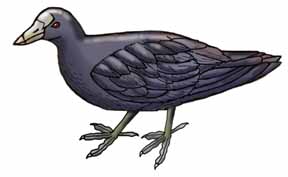
They are duck-like birds that are overall dark gray with a small white patch under the tail. They have a white bill with a red bulge at its base between the eyes and a vertical black line near the tip. They have webbed feet with a lobe on each toe that makes them powerful swimmers. They can fly, but have short, rounded wings that makes taking off more difficult. They reach about 15 inches (38 cm) long and weigh about 2 pounds.Habits
They gather in small groups and will migrate as a flock. They must run across the water to gain flight (like a loon) and cannot off take off quickly when threatened. Instead they have been known to splash water at potential predators.Diet
They are omnivores, eating small fish, tadpoles, snails, crayfish, insects and water plants.Predators
Adults are sometimes killed by eagles or osprey and hatchlings are eaten by coyotes, foxes, raccoons and snapping turtles.Reproduction
Females lay up to 10 pink eggs with brown spots in a nest on the edge of the water hidden in the vegetation. Both parents keep the eggs warm (incubation) until they hatch (after about 2 weeks) and then both will care for and feed the chicks. They build a ramp from the nest down to the water so the hatchlings can reach it. The parents will teach the hatchlings to dive for food and after about a month, they can do it on their own. Flight follows a few weeks later. By the end of 2 months, they can live on their own.Lifespan and/or Conservation Status
They can live about 10 years in the wild. They are listed as least concern on the IUCN Red List.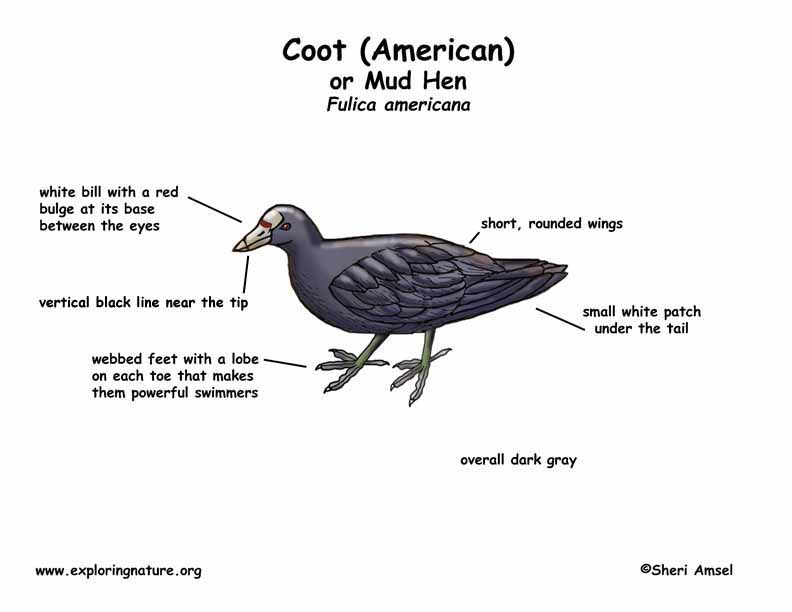
Classification
- Kingdom: Animalia
- Phylum: Chordata
- Subphylum: Vertebrata
- Class: Aves
- Order: Gruiformes
- Family: Rallidae
- Genus: Fulica
- Species: F. americana