

Molothrus ater
Range
Cowbirds once only lived on the short-grass prairies of the Midwest. Then, after the pioneers came and cut forests and brought in cattle, the cowbird’s range spread. Now they are found all over the U.S. and southern Canada.
Habitat
They are found in fields, along the edges of forests, on farmland and even golf courses.
Body Traits
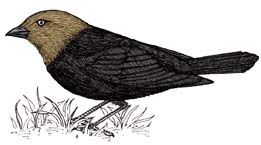
They are a dark bird with a brown head down to their shoulders and the rest of the body is black. Females are a dull gray-brown.
Habits
They are called cowbirds because they once followed the herds of buffalo (and cattle). When the herds moved, they kicked up insects from the grass that the cowbirds ate.
Diet
They eat insects.
Reproduction
Females lay their eggs in other birds’ nests to be raised by other females. This is called “parasitic.” The cowbird female can lay one egg per day to place in other birds’ nests. They can lay as many as 40 eggs from May to July! The cowbird perches up high and watches other birds build their nests. Then, when the other bird is not looking, she will lay her own egg in the nest. Most birds do not know the egg is not theirs and will warm it and feed the chick when it hatches.

Classification
Kingdom: Animalia
Phylum: Chordata
Subphylum: Vetebrata
Class: Aves
Order: Passeriformes
Family: Icteridae
Genus: Molothrus
Species: M. ater