

Buceros bicornis
Range
They are found in India, China, Southeast Asia, Malaysia and Indonesia.
Habitat
They live in evergreen and wet deciduous forests. They especially like to nest in tall, emergent trees.
Body Traits
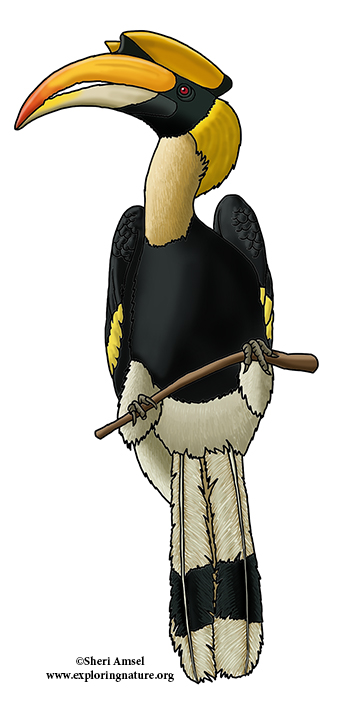
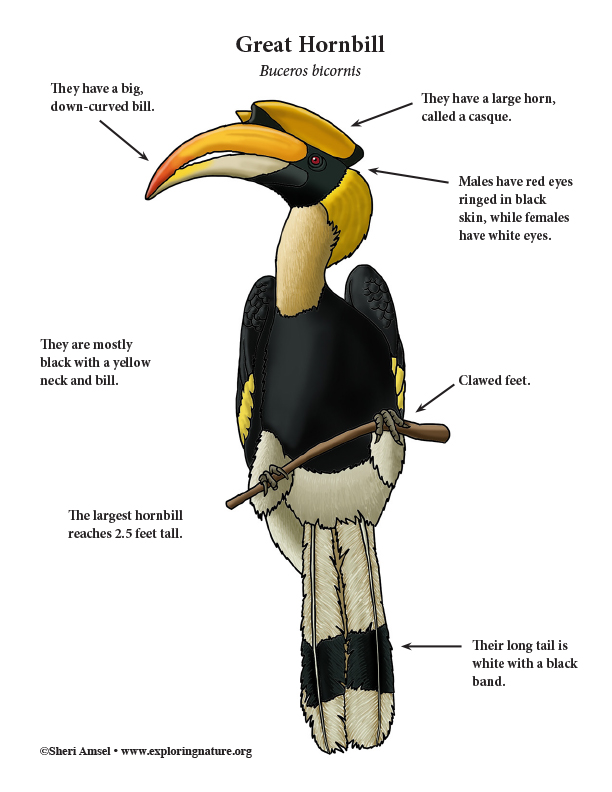
This largest hornbill reaches 2.5 feet tall. They have a large horn, called a casque, on their big down-curved bill. This may attract a mate and be used by males in dominance battles. They are also involved in their calls. It is bigger in males. They are mostly black with a yellow neck, lower abdomen and bill. Their tail is white with a black band. Their coloration is affected by the hornbill’s oil glands, which they use in preening. Males have red eyes ringed in black skin, while females have white eyes and pink skin.
Habits
They are active during the day (diurnal). At night they will gather and sleep (roost) with may other hornbills. Their calls are loud and a roost site can be a very noisy place. They are territorial and the males will fight with their casques
over territory and females.
Diet
They eat mostly fruit, but will also eat lizards, small mammals, and insects. They help spread forest seeds.
Reproduction
They breed in late winter through the spring. The female nests in a hollow tree. She seals herself in while she lays the eggs, usually
two, and raises the young. The male will bring her fruit and push it through a tiny opening. The female will molt while sealed safely in
the tree. Once the chicks hatch, the female will stay inside with them for another 5-6 weeks while they grow. Then she’ll knock her way out, reseal the hole and start helping the male collect food for the growing chicks for another couple of weeks. Even after the chicks are released, the parents will feed them until they are almost 4 months old. Then they are on their own.
Lifespan and/or Conservation Status
They are thought to be able to live for 40 years in the wild. On the IUCN Red list, they are considered “near threatened.”
Classification
Kingdom: Animalia
Phylum: Chordata
Subphylum: Vetebrata
Class: Aves
Order: Coraciiformes
Family: Bucerotidae
Subfamily: Bucerotinae
Genus: Buceros
Species: B. bicornis