

Lepus americanus
Range
Snowshoe hares are found throughout most of North America.Habitat
Snowshoe hares live in conifer and leafy (deciduous) forests and brushy areas where there is lots of food and shelter.Body Traits
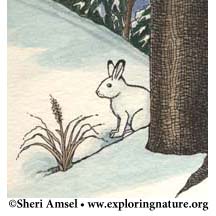
They have large feet for traveling on top of the snow. Their brown fur turns white in winter. They have long ears, though much smaller than jackrabbits.Habits
They are active all winter, feeding in the early morning, dusk and at night. When confronted with a predator, they may stay perfectly still as their fur blends in well (camouflage) with their habitat. However, they also may run. They are very fast and can change directions and leap into the air suddenly to elude predators.Diet
They eat deciduous trees and shrubs, some conifers, grass, and wildflowers.Predators
They are an important food source for many predators. Fox, coyote, owls and hawks all feed on them. The Canadian lynx’s diet is mostly snowshoe hares. When there are fewer hares, there are fewer lynx.Reproduction
Snowshoe hares usually have 2-3 litters a year from April to August. Females are pregnant for about 35 days (gestation), having up to 8 young.Lifespan and/or Conservation Status
Snowshoe hares live about 3 years in the wild.
Classification
- Kingdom: Animalia
- Phylum: Chordata
- Class: Mammalia
- Order: Lagomorpha
- Family: Leporidae
- Genus: Lepus
- Species: L. americanus