

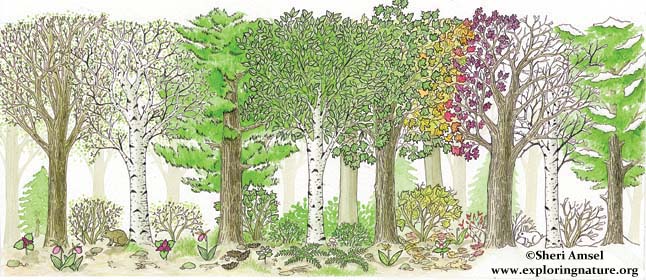
Trees can be divided into two main groups: Conifers (gymnosperms) and Deciduous (angiosperms).
Conifers have leaves that are green needles. Most keep their green needles all year long, except tamaracks/larch. Conifers have cones. Female cones carry the seeds. Male cones release pollen. At certain times each year, pollen is released and sent by the wind to find the seeds. The seed cones are pollinated producing fertile seeds. When the cones are dropped or harvested by animals, seeds dropped into the soil produce new conifers.
The conifers you might find on your nature trail are: white pine, red pine, balsam fir, spruce, hemlock and tamarack. (There are many more, this is a small sampling.)
Deciduous trees have green leaves. They lose their leaves every autumn and grow them back each spring. Deciduous trees have flowers that are also pollinated by the wind or insects and produce seeds inside a fruit. The fruits falls or is eaten and distributed by an animal. Deciduous tree flowers can look like standard flowers or they can be very different like a catkin as on most forest trees.
Deciduous trees make a variety of fruits (with the seeds inside) i.e. apple trees-apples, maple trees-samaras, oak trees – acorns, birch trees make cone-like fruit called strobile, cottonwood trees make seeds on fuzzy parachutes.
Activity – Identifing Trees:
We have supplied a 3-page Dichotomous Key below to help you identify the trees in your schoolyard.
Dichotomous keys are easy to use after some practice. Bring your printed key out into the schoolyard and choose a tree to identify. Note that each step of the key usually has two choices. After identifying the trait, move onto the next step until you reach the name of your tree.
If you reach a step with vocabulary you do not know, take a moment to look up the word before moving on. Once you are comfortable identifying trees, make a map of all the trees in your schoolyard.
Download and print out the pdf below for Tree ID.