

Tyto alba
Range
They are found from the southern tip of British Columbia, Canada through the northern U.S. south into Central and South America and even the Caribbean. They are also found in Africa, Europe, Southeast Asia, and Australia.
Habitat
They are found in grasslands, deserts, marshes, and farm fields. They are found in the most places on earth (all continents except Antarctica).
Body Traits
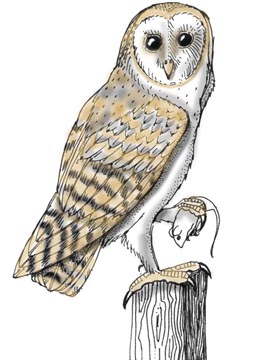
They are medium sized owls, reaching 16 inches tall. They have white faces, chests and bellies with black spots. Their backs are grayish-brown with white spots. They have a heart-shaped face and long legs. Females and males look alike, though the females are usually bigger and even more spotted and darker than the males.
Habits
They hunt at night (nocturnal) with their great night eye sight (vision) and hearing. They fly low over the ground to look for prey.
Diet
They eat small mammals.
Reproduction
They nest in hollow trees, cliff holes, barns or other out buildings, and nest boxes. Their nests are cup-shaped and made from the scraps they spit up after eating prey (owl pellets). Females lay 3-9 white eggs.

Classification
Kingdom: Animalia
Phylum: Chordata
Subphylum: Vetebrata
Class: Aves
Order: Strigiformes
Family: Tytonidae
Subfamily: Tytoninae
Genus: Tyto
Species: T. alba