

Bubo virginianus
Range
They are one of the most common owls in North America. They are found in Alaska, all across Canada, the U.S., Mexico, Central America and in some areas of South America.
Habitat
They are found in a many habitats, but like open areas, woodlands and farms. Also found in coniferous forests, deserts, towns and cities.
Body Traits
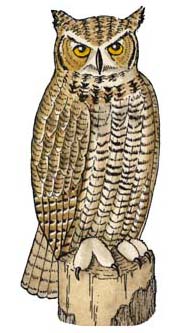
The largest owl, they can be up to 2 feet tall. They have ear tufts on their heads that look like ears (but aren’t). They are brownish-gray with dark stripes (called barring). They have a white throat, yellow eyes and a rounded face with a dark ring around it. Both males and females look the same, but females can be bigger.
Habits
They hunt at night by sitting on a high place and looking out over an open area like a field or parking lot.
Diet
They eat many kinds of animals, mostly mammals like mice, voles and rabbits, but will also eat birds like geese and herons. They also will eat snakes, frogs and insects.
Reproduction
They nest in trees, on cliffs, buildings, and even on the ground. They don’t make their own nests. They take over nests made by other birds. Females lay 1-5 round white eggs.

Classification
Kingdom: Animalia
Phylum: Chordata
Subphylum: Vetebrata
Class: Aves
Order: Strigiformes
Family: Strigidae
Genus: Bubo
Species: B. virginianus