

Eudyptes chrysocome
Range
They are found on islands around Antarctica and north to Chile, Argentina, South Africa and New Zealand.
Habitat
They nest on cliffs and rocky places near freshwater.
Body Traits
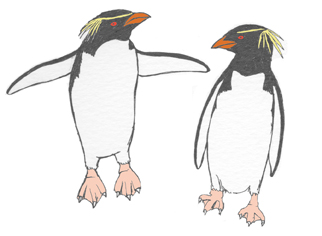
They are one of the smallest penguins. They are less than 2 feet tall and weigh about 5.5 pounds. They look a lot like macaroni penguins. They have a yellow feather crest on top of their heads and a yellow line from each eye backward. They are dark gray on back and white on front. Their eyes and bill are red.
Habits
They live in groups, diving for food together. They can dive up to 300 feet in search of food. They move differently from some penguins that waddle or slide across the ice on their bellies. Rockhoppers hop from rock to rock or along the ice pack. They groom their waterproof coat of feathers with a waxy coating.
Diet
They eat fish, squid, octopus and other small ocean animals.
Reproduction
They breed in large groups (colonies). They stay with the same mates year after year and even use the same nest. The female lays 2 eggs in November. One is always larger than the other. That is the chick that will survive. The male and the female take turns warming (incubating) the eggs for about a month. They have a bare patch of skin on their lower belly (‘brood pouch’) that sits right over the eggs and warms them. After they hatch, the male stays with them for a month while the female feeds in the ocean and brings back food for the chicks.

Classification
Kingdom: Animalia
Phylum: Chordata
Subphylum: Vetebrata
Class: Aves
Order: Sphenisciformes
Family: Spheniscidae
Genus: Eudyptes
Species: E. chrysocome