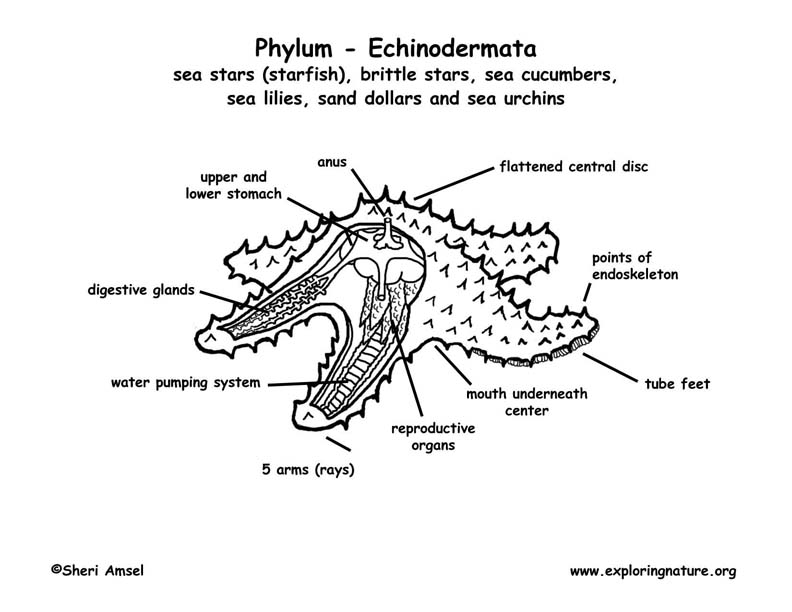
There more than 6,000 species of echinoderms. They include sea stars (starfish), brittle stars, sea cucumbers, sea lilies, sand dollars and sea urchins.
Range and Habitat: They are all found in the world’s oceans (marine habitats).
Physical Traits (Anatomy): Echinoderms have radial symmetry, which means they can be cut in half from top to bottom and the two sides would be roughly the same. They have an internal skeleton, called an endoskeleton, that is made up of spiny plates that protrude out of their skin.
They breathe through small finger-like extensions called skin gills.
They have a a primitive nervous system made up of a central nerve ring with branches leading out to the rest of the body.
They move on delicate tube feet that are attached to the body’s vascular system. Echinoderms use this to move along the ocean floor. The vascular system pulls sea water into the body
They have separate sexes. Both release their eggs or sperm into the seawater where fertilization occurs. They develop into free-swimming larvae that grow and develop into the adult form.
Examples of Echinoderms:
In the Class Asteroidea are the starfish.
Physical Traits: They are flattened with a central disc. They 5 (or multiples of 5) arms or rays that extend out from their central disc. Each arm has rows of tube feet underneath with which they move and grasp prey.
Diet: They eat bivalves – clams, oysters and scallops. They use the powerful suction of their tube feet to pull open the shells of their prey. They don’t need to open them very wide to feed. They feed by pushing their stomach out of their mouths and into the open clam. The stomach secretes its powerful digestive enzymes right into the clam and begins digesting it while it continues to hold the shell open.
In the Class Echinoidea are the sand dollars and sea urchins. They have one flattened endoskeleton plate with pores through which extend their breathing tube feet. These pores form a flower-like pattern that can be seen clearly on their skeleton after death. In life they have sharp spines that they use to move along the ocean floor or burrow in the sand. They also use them as a defense against predators.