

Lagopus lagopus
Range
They are found in northern Asia, northern Europe, Alaska and across Canada to Labrador. They can travel south in winter (migrate).
Habitat
They live on the tundra and in alder and willow thickets.
Body Traits
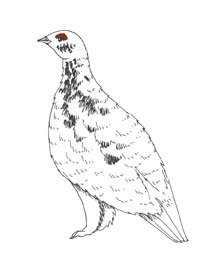
They are small with a red comb over their eyes that get bigger in the spring and summer. They have spotty areas of brown on their back, neck and head. In the winter they turn mostly white and grow feathers on their legs and feet to protect them from the cold.
Habits
They will fly into a snow bank at night to sleep or during a blizzard or cold snap. The snow helps protect them from wind and cold (insulates them). They fly in to force their way deeper into the snow to keep warm and because it leaves no scent trail for predators to find them. In a habitat where there are no trees for the birds to sleep up in (roost), a snow bank can be the safest place.
Diet
They eat plants and insects in the summer and willow and alder buds and twigs in the winter.
Reproduction
A female nests in a low spot on the ground protected by rocks or bushes. She lines it with grass and feathers. Then she lays 7-10 eggs. The male guards them, while the female warms (incubates) the eggs.

Classification
Kingdom: Animalia
Phylum: Chordata
Class: Aves
Subclass: Neornithes
Infraclass: Neognathae
Superorder: Galloanserae
Order: Galliformes
Family: Phasianidae
Subfamily: Tetraoninae
Genus: Lagopus
Species: L. lagopus