

Fratercula arctica
Range
They summer on islands off the coast of Maine and north to Newfoundland. They are also found across the North Atlantic in Northwestern France on the coast of the Brittany Peninsula, Ireland, and the UK. They spend the winter at sea in the North Atlantic off the areas where they breed in summer.
Habitat
They live on the ocean. They come to rocky islands to breed.
Body Traits
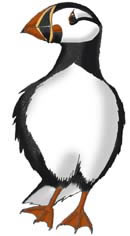
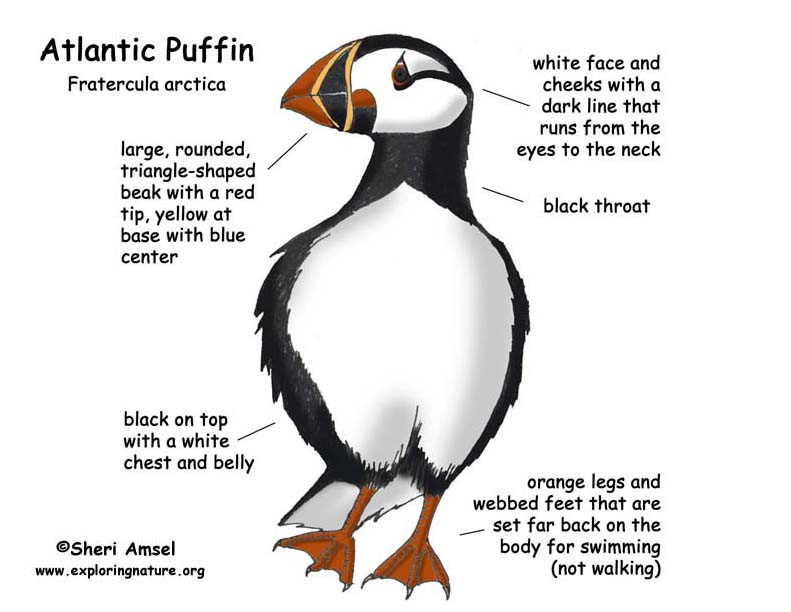
They are mostly black on back with a white chest, belly and under parts and face. They have a black neck. They are most well known for their large colorful, triangle-shaped bill and face markings. The Atlantic puffin’s bill has a red tip and two yellow bands with dark blue between them. They have a dark band that runs from their eye backward. They have orange legs and feet. Their legs are set back on their bodies. This helps with swimming is not as good for walking. Both males and females look alike. They can reach more than a foot long and weigh about 1 pound.
Habits
They are an ocean bird, only coming to land to breed. When feeding, they dive into the ocean and swim underwater, catching and eating prey under water. When fishing to feed their young, they carry small fish clamped in their jagged bill back to the nest.
Diet
They eat fish, mollusks (clams, snails and squid) and small crustaceans (crabs and barnacles).
Reproduction
They breed in colonies on rocky islands in the North Atlantic from April to August. The female lays 1 egg. Both parents take turns warming it (incubating) for more than a month. Once it hatches they feed it small fish more another month or two. By then it can fly and leaves the nest on its own.
Classification
Kingdom: Animalia
Phylum: Chordata
Subphylum: Vertebrata
Class: Aves
Order: Charadriiformes
Family: Alcidae
Genus: Fratercula
Species: F. arctica