

Geococcyx californianus
Range
They are found mostly in the southwestern U.S. and south into Mexico, but less commonly can be seen in Colorado, Kansas, Texas, Oklahoma, Louisiana, and Arkansas.
Habitat
They live in arid desert, scrublands, and dry grasslands.
Body Traits
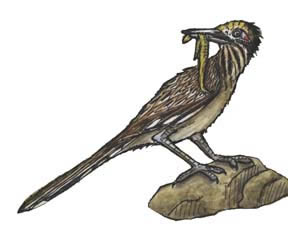
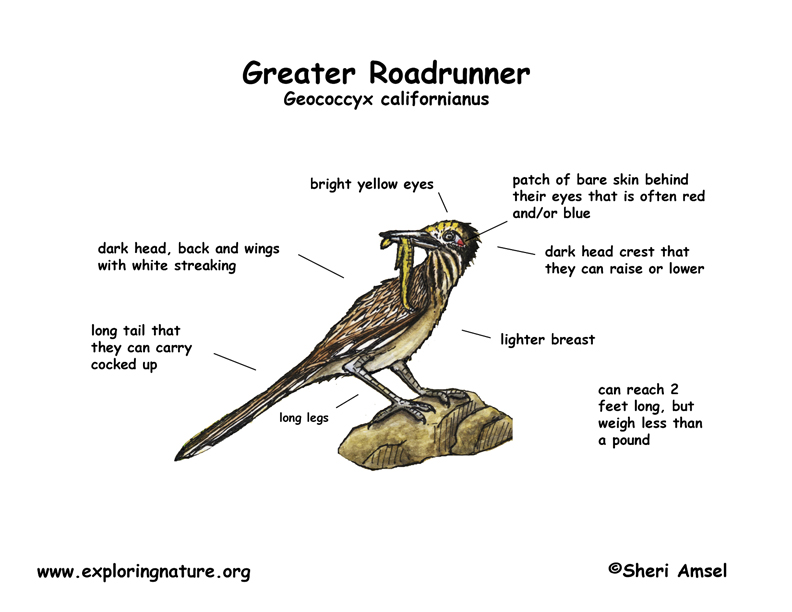
They can reach 2 feet long, but weigh less than a pound. They have a dark head, back and wings with white streaking. They have a lighter breast. Their eyes are bright yellow and they have bare skin behind their eyes that is often red and/ or blue. They have a long tail that they can carry cocked up and long legs. They have a dark head crest that they can raise or lower. Males and females look alike.
Habits
They will beat large prey to death against a rock. They run along the ground at more than 15 mph.
Diet
They eat invertebrates (insects, scorpions, spiders, etc.) lizards, birds, small animals, eggs and dead animals found.
Reproduction
Females guild a nest of sticks in a thorny tree or cacti and lay up to 8 off white eggs. She tends the chicks for about a month until they fledge.
Classification
Kingdom: Animalia
Phylum: Chordata
Subphylum: Vertebrata
Class: Aves
Order: Cuculiformes
Family: Cuculidae
Subfamily: Neomorphinae
Genus: Geococcyx
Species: G. californianus