

Sturnus vulgaris
Range
They live in Europe and Asia and were introduced to North America in the late 1800s in NYC. They were so successful that they have spread throughout North America and number in the many millions.
Habitat
They are found around farms, parks and yards.
Body Traits
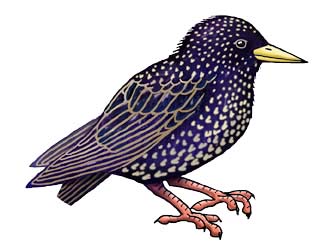
They are dark with brownish wings and a shiny blue or green head and chest in the light. The body is speckled with light flecks in the winter months. They have a short tail, yellow beak and pink feet. They reach about 8.5″ (21 cm).
Habits
They travel in large flocks and can be aggressive with other birds. As their numbers rose in North America in the last century, they forced other birds – like swallows and bluebirds – out of their habitats.
Diet
They eat insects, grain, fruit, and seeds, feeding in large flocks.
Reproduction
They nest in tree holes, laying about five light blue eggs. Males often begin the nest building as a way to attract a mate. They also attract females with song. They may raise as many as three clutches of young in a season.

Classification
Kingdom: Animalia
Phylum: Chordata
Subphylum: Vertebrata
Class: Aves
Order: Passeriformes
Family: Sturnidae
Genus: Sturnus
Species: Sturnus vulgaris