Facts about Teeth
1. They are for chewing food (mastication).
2. There are 32 permanent teeth – 8 incisors, 4 cuspids, 8 bicuspids, 8 molars.
3. Humans first grow baby teeth (deciduous teeth), which come in at 6-12 months and fall out at from 6-12 years old.
4. The permanent teeth are all in by adolescence (except for 3rd molars – wisdom teeth – which are usually pulled out).
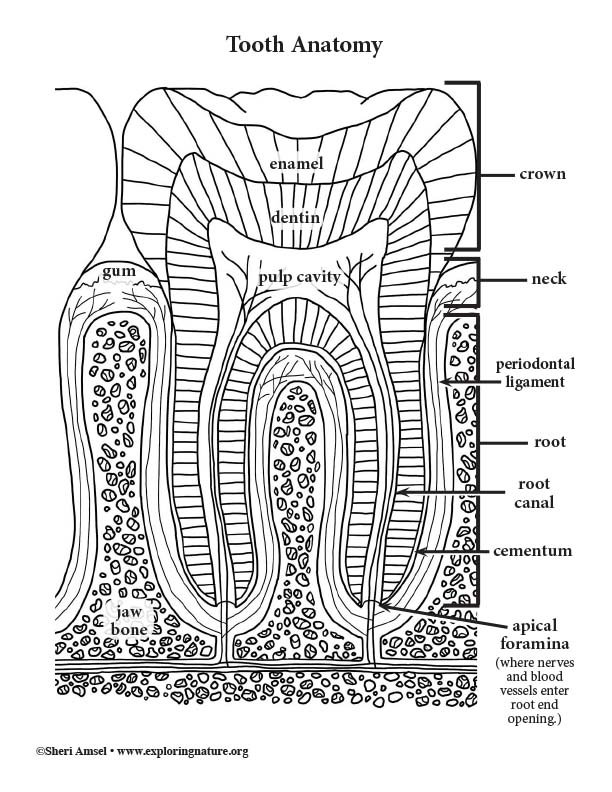
5. The portion of tooth embedded in the jaw is the root.
6. The portion of the tooth visible above the gum (also called gingiva) is the crown.
7. The crown is covered with enamel.
8. The line where the crown and root meet is called the cervical line or the cementoenamel junction. This area is called the neck.
9. The tooth is composed of 4 tissues:
a. Enamel
• Covers the crown.
• Is made up of mineralized calcium salts – hardest substance in body.
• Is calcified and resembles bone, but is avascular.
b. Dentin
• Is bone-like material that forms the bulk of the tooth.
• Surrounds central pulp cavity.
• Is calcified and resembles bone but is avascular.
c. Pulp
• Pulp cavity has blood vessels and nerves.
• It extends into the root via root canal.
• It is lined with odontoblasts – which secrete dentin.
• Blood vessels and nerves enter the pulp cavity via the apical foramina.
d. Cementum
• Hard calcified connective tissue covering root.
• Produced by cementocytes.
• Provides attachment for tooth to bony alveolus of jaw.
• Tooth anchored to jaw by periodontal ligament (periodontal membrane).
• Calcified and resembles bone, but is avascular.
After reading about tooth anatomy and studying the diagram, click the quiz button.