

Nestor meridionalis
Range
They are found on the South and North Islands of New Zealand and some offshore Islands.
Habitat
They live in the forests. They need large wild forest habitats.
Body Traits
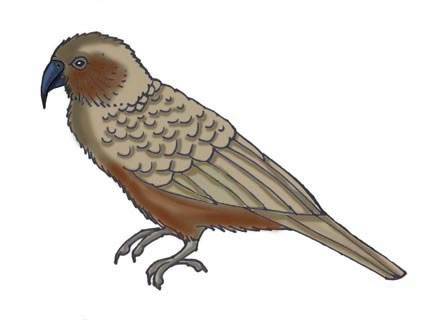
They are large parrots. They can reach 18 inches tall. They are brown and green parrots with bright orange and red patches under their wings. The Kaka on the South Island is bigger and brighter colored. They have a special tongue shaped like a brush for collecting flower nectar. They help many flowers pollinate. They have a strong bill they use for climbing tree trunks and breaking into tough seed cones.
Habits
They are active during the day (diurnal) or at night during a full moon when there is light. They are found in large, noisy flocks in the dawn and dusk. They hold food with their feet and climb with their beaks! Because their predators are all introduced animals, kaka have been become endangered. They have not had time to evolve and adapt to the new predators. Young kaka leave the nest before they can fly so are killed by cats and weasels (stoats).
Diet
They eat flower nectar, fruit, insects, grubs and seeds.
Reproduction
Females warm (incubate) eggs for 3 weeks. They nest in hollow trees where, sadly, introduced predators can kill them easily.

Classification
Kingdom: Animalia
Phylum: Chordata
Subphylum: Vetebrata
Class: Aves
Order: Psittaciformes
Family: Strigopidae
Genus: Nestor
Species: N. meridionalis