

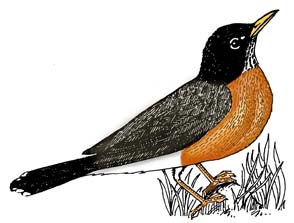
Turdus migratorius
Range
They are found all over the U.S. and Canada except for Hawaii and the northern most parts of Alaska and Canada. They spend the winter in Mexico and Central America, though not all robins travel south (migrate).
Habitat
They live in open woodlands, farms, fields, and towns.
Body Traits
They are a big songbird, reaching up to 11 inches tall. They are gray above with a darker head and tail and rusty-orange below.
Habits
Male robins sing to protect their territory and to attract a mate. They are one of the first birds heard in the spring.
Diet
They eats worms and insects.
Reproduction
They mate in the spring and the female may have 2 – 3 sets of eggs (broods) each season. The female builds an open cup nest of twigs and grass with mud spread on the inside then lined with grass. The male helps collect things for the nest. The nest is built five to fifteen feet above the ground in a tree or bush. Sometimes a robin will build its nest on a window ledge. She lays 3 – 5 blue eggs and warms (incubates) them for about 2 weeks.

Classification
Kingdom: Animalia
Phylum: Chordata
Subphylum: Vertebrata
Class: Aves
Order: Passeriformes
Family: Turdidae
Genus: Turdus
Species: T. migratorius