

Tympanuchus cupido
Range
They once lived all over the U.S. and Canada in open prairie and mixed oak forests. Now they can only be found in some open grasslands ranges in 10 prairie states. Most of their habitat has been plowed under for farms or over grazed by cows.
Habitat
Prairie chickens need open, tall grass prairie and shrubby, grassy areas along the edge of forests. The tall grass protects them from strong winds and heavy rain.
Body Traits
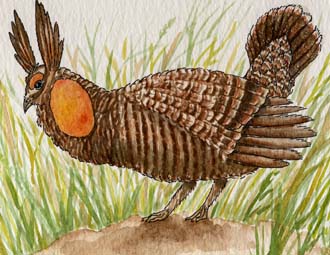
They are big birds — up to 18 inches long. They have brown and tan stripes on white (called barring). Their tail is short and square. It is dark brown on the males and barred on the females. They have feathers on their legs. The males have orange air sacs and eyebrows in the spring that they use to display to females.
Habits
In the spring, males stand on a small rise and display to attract a mate. They puff up their orange cheek patch and stamp their feet and dance. This is called “booming.” They feed early in the morning and late in the afternoon, resting during the heat of the day.
Diet
They eat plants and insects and grain left over in farm fields. Chicks eat a lot of insects.
Reproduction
From early spring though June, the males dance, call and fight with other males. The small rises where they display are called “booming grounds” or “leks.” Females visit them in their territories to mate. Their nests are simple, saucer-shaped piles of dead grass. They lay a dozen grayish-green eggs with tiny spots and sit on them for 3 weeks (incubation).
