

Aegolius acadicus
Range
They are found North America from Alaska across Canada to New Brunswick and throughout the U.S. into Mexico.
Habitat
They are found in forests with undergrowth and shrubs. They especially like deciduous forests (where leaves drop in winter) where woodpeckers leave holes for them to use as nest sites. They like wetter areas.
Body Traits
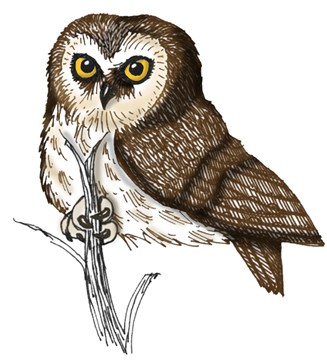
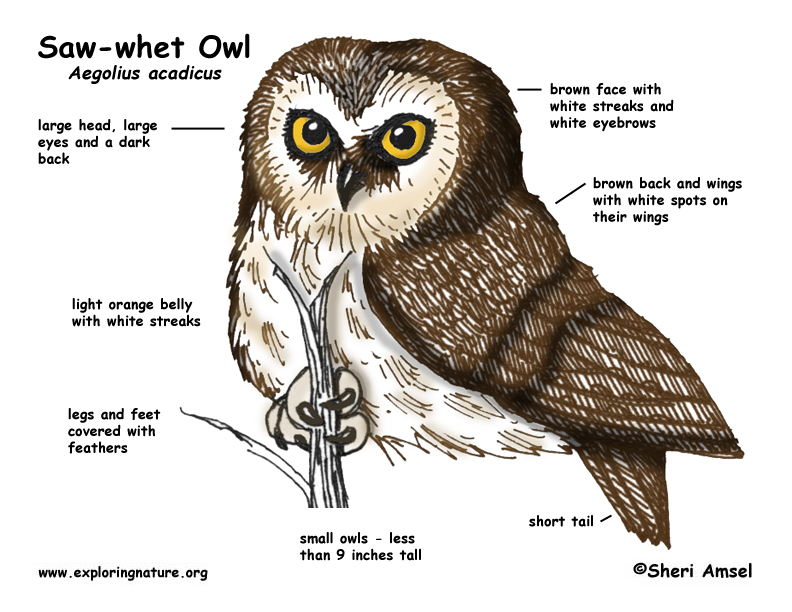
They are very small owls, growing to less than 9 inches tall. They have a short tail, with a large head and eyes and a black beak. Their faces are brown with white streaks and white eyebrows. They have brown backs and wings with white spots on their wing feathers. Their bellies are more orange with white streaks. Their legs and feet are covered with feathers.
Habits
They hunt at nightfall, sitting up high and dropping down onto prey. They are active only at night. During the day they hide in brush near the ground. They are fast flyers.
Diet
They eat small mammals, like mice, shrews and voles. Sometimes they will eat small birds, frogs and insects.
Reproduction
Males attract females with songs and may offer them a dead mouse. They nest in spring to early summer, in old woodpecker holes or natural tree holes. Females lay 3-7 eggs and warm them for 4 weeks until they hatch (incubates), while males bring food to her and defend the nesting area.
Classification
Kingdom: Animalia
Phylum: Chordata
Subphylum: Vetebrata
Class: Aves
Order: Strigiformes
Family: Strigidae
Genus: Aegolius
Species: A. acadicus