

Struthio camelus
Range
They are found in East and South Africa.
Habitat
They live on the dry grassland savannas and in some areas of the Sahara desert.
Body Traits
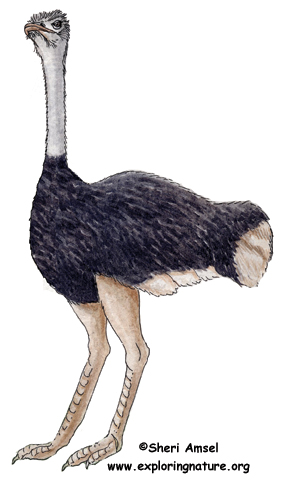
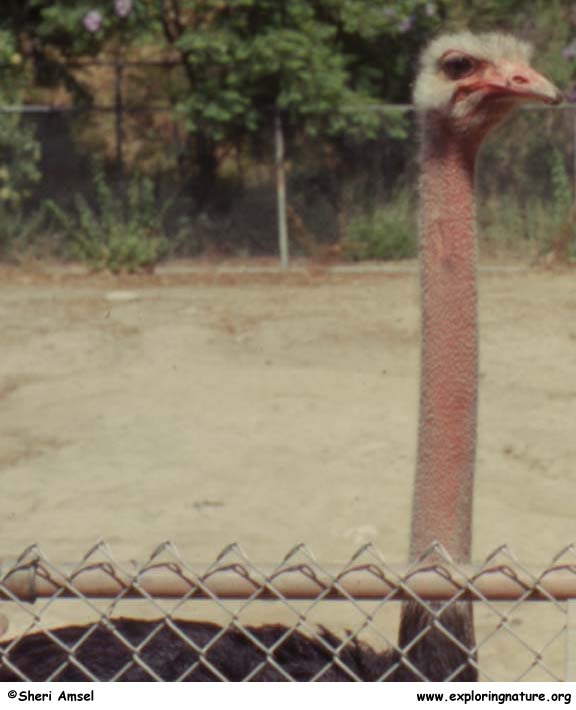
The ostrich is the largest living bird. An adult male can stand nearly 8 feet tall and weigh more than 200 pounds! They have small wings and cannot fly, but have split hooves with 2 toes and long, strong legs for running. They have soft, thick feathers that protect them from the heat of their habitat and thick eyelashes to protect their eyes from sand storms. They also have great eyesight and hearing to watch for predators.
Habits
Many of the animals grazing on the grasslands depend on the ostrich to let them know when predators are near. They run very fast from predators but also can run a long ways to look for food and water. If attacked, an ostrich has a powerful kick with which to defend itself. They can live from 30 – 70 years!
Diet
Ostriches eat seeds, grass, leaves, and bushes. They sometimes eat insects and lizards too.
Reproduction
The male ostrich has a group (harem) of 3 – 5 females, who all lay their eggs in the same nest for about 3 weeks (polygamous) right before the rainy season. He makes the nest, which is just a dent scratched in the ground that holds up to 25 big, white, round eggs. Only about half the eggs will make it to hatching, because of predators. The males warm (incubates) the eggs at night.

Classification
Kingdom: Animalia
Phylum: Chordata
Subphylum: Vetebrata
Class: Aves
Order: Struthioniformes
Family: Struthionidae
Genus: Struthio
Species: S. camelus