

Callipepla gambelii
Range
They are found in the southwestern U. S. throughout Arizona with scattered populations spreading outward into regions of Texas, California, Utah, Colorado and Nevada and south into Mexico. They have been introduced to areas in Hawaii.
Habitat
They live in desert areas that receive enough rainfall to have dense brushy cover and dry scrubby forests. They use the thorny vegetation of mesquite, desert hackberry, catclaw acacia and other desert shrubberies as protection from predators and for shade from the hot desert sun.
Body Traits
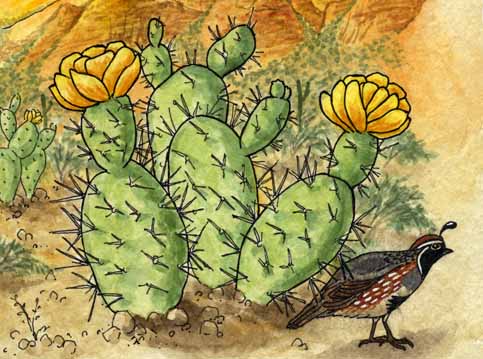
They are small, rounded birds about a foot long and weighing about 6.5 ounces. They have a black face and neck framed by a white border and a chestnut cap. An eye-catching black plume comes off the top of the head. They are grayish brown on top with rusty sides covered in small white spots. Their underside is lighter, but has a marked black patch on the belly. Females are much duller in color.
Habits
They are active during the day (diurnal) running along the ground to escape danger. They can fly and use flight to reach tree roosts at night or cross rivers or roads, but they prefer to run. They travel in small family groups called a covey that are made up of the parents and their many young from that breeding season. They search the ground for food in the cool of the morning and afternoon and rest in the shady brush midday.
Diet
They eat seeds, leaves, fruits, berries and sometimes insects. They will feed on grain if they come across a farm field. They don’t need to drink water, but will if they find a source.
Predators
They are eaten by hawks, foxes, coyote, bobcats, snakes and man.
Reproduction
Females lay up to 12 white eggs with brown spots in a nest made of grass, leaves and twigs and lined with their own soft feathers. Nests are hidden under shrubbery on the ground or under a rocky outcropping. If available, they may build the nest in a scrubby tree. Males will help warm (incubate) and protect the eggs and the new hatchlings. They take 3.5 weeks to hatch and very quickly are running along the ground feeding themselves.

Classification
Kingdom: Animalia
Phylum: Chordata
Subphylum: Vertebrata
Class: Aves
Order: Galliformes
Family: Odontophoridae
Genus: Callipepla
Species: C. gambelii