

Callipepla californica
Range
They are found on the Pacific Coast of North America from Baja California to Oregon. They have spread (by introduction) to Nevada, New Mexico, Hawaii and Utah. They have also been introduced to South America (Chile), Canada (British Columbia) and New Zealand.
Habitat
They live in open woodlands, scrubby forests, stream valleys, farmlands and even suburban gardens.
Body Traits
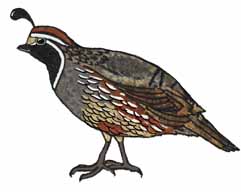
They are small, rounded birds about a 10 inches long and weighing about 6 ounces. They have a black face and neck framed by a white border and a chestnut cap. An eye-catching black plume (or two) comes off the top of the head. They are bluish-gray to brown on top with rusty sides and a lighter underside. The belly is marked by black scallops that look like fish scales and a yellow cast. Their legs and feet are gray. The beak is dark. Females are much grayer in color.
Habits
Throughout the year, they travel in large groups called coveys. In the spring, the groups break up into mated pairs for breeding and nesting. They can run along the ground at surprising speeds (more than 10mph!) when escaping predators.
Diet
They eat plants and seeds mostly, but will also eat fruits, berries and even insects when available.
Reproduction
Females lay anywhere from a half dozen to more than 2 dozen white eggs with light brown spots in a grass-lined nest scraped into the ground in late spring (May-June). Females warm the eggs (incubate) for a little over 3 weeks while the male brings her food. Males will hatch the eggs if the females are lost to predation. Chicks begin to run around and search for food very soon after hatching.
Lifespan and/or Conservation Status
They are listed as least concern by the IUCN Red List.

Classification
Kingdom: Animalia
Phylum: Chordata
Subphylum: Vertebrata
Class: Aves
Order: Galliformes
Family: Odontophoridae
Genus: Callipepla
Species: C. californica