

Anas acuta
Range
They are found throughout the world – breeding in the Northern Hemisphere and wintering in the Southern Hemisphere. In North America, they breed in Canada, Alaska and the northern U.S. and winter across the southern U.S., along the coasts and south through Mexico all the way to northern South America.
Habitat
They live in wetlands – lakes, ponds, rivers, marshes and wet fields.
Body Traits
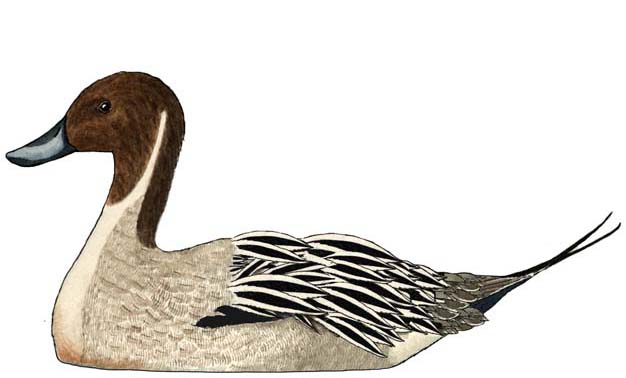
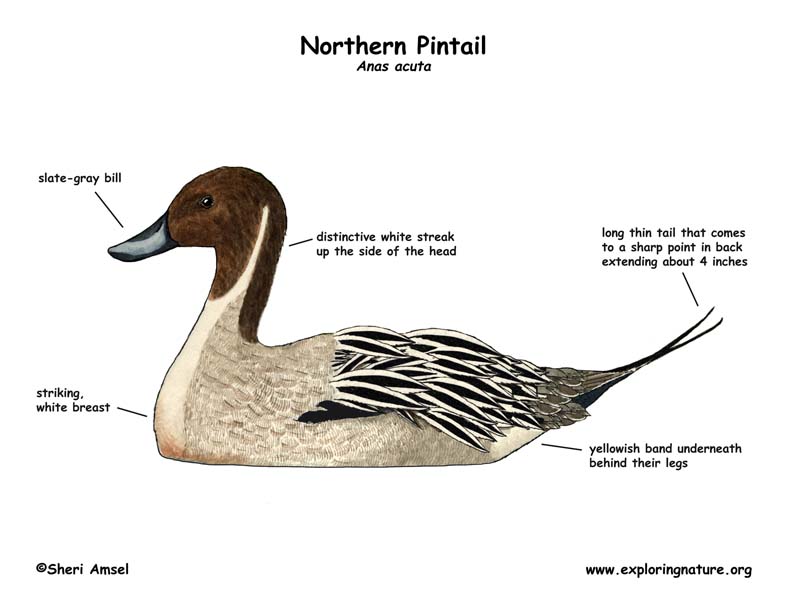
Males are slightly larger and more distinctly marked than than females which are dull grayish-brown (sexual dimorphism). Males have a dark head and a striking, white breast that continues up into a distinctive white streak up the side of the head. They have a long neck and slate-gray bill. The body is dark on top, gray on the sides and has a yellowish band underneath behind their legs. Another distinctive feature is a long thin tail that comes to a sharp point in back extending about 4 inches – the pin tail.
Habits
Pintails up end to feed by submerging the front half of their body and leaving just the tail above water. They are often seen feeding in small groups with many other species.
Diet
They eat invertebrates – snails, water insects and plant matter. They will take advantage of grain fields if available.
Reproduction
Females lay up to 9 cream-colored eggs and incubate them for 3 to 3.5 weeks. Then she’ll bring the hatchling to water and teach them to forage for dead insects. The females stay with her brood for about 7 weeks.
Classification
Kingdom: Animalia
Phylum: Chordata
Class: Aves
Order: Anseriformes
Family: Anatidae
Subfamily: Anatinae
Genus: Anas
Species: A. acuta