

Bucephala albeola
Range
They breed in northern North America – Canada, Alaska and in a few spots in the northern U.S. They winter on the east and west coast (or inland on large bodies of water, saltwater bays and tidal marshes).
Habitat
They live near ponds and wetlands in boreal forests. They winter on saltwater.
Body Traits
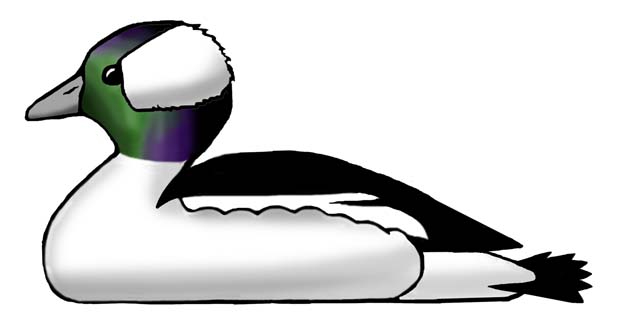
They are small ducks with pink feet. Males are more striking than the females, which are grayish-brown (sexual dimorphism). Males have a black head that shines green and purple (iridescent) and a large white check patch that extends to top of the head. They are white underneath and shiny black on top. They have a slate gray bill – female bills tend to be darker. Females do have the white check patch though it’s smaller and less distinct.
Habits
They spend most of their lives in the water, rarely walking land. They are often in small flocks while they feed and migrate. They are territorial and males will battle over females with wing flapping and dive bombing behavior.
Diet
They eat water insects, insect larvae and other invertebrates (snails, etc.). They also eat small fish, fish eggs, seeds and plant matter.
Reproduction
Females lay up to 11 greenish-brown eggs in a found tree cavity nest near water. They incubate the eggs for a month and stay with hatchlings for another month to 6 weeks until they are independent. Males stay with their mate while she lays the eggs and begins incubation, but do not help incubate or care for chicks.

Classification
Kingdom: Animalia
Phylum: Chordata
Class: Aves
Order: Anseriformes
Family: Anatidae
Subfamily: Merginae
Genus: Bucephala
Species: B. albeola