Only subscribers can access printable PDFs and other resources, please login or subscribe.
School subscribers can also access more than 200 downloadable bundles in ourstore for free (a value of $1,500).
District subscriptions provide huge group discounts for their schools. Contact Sheri for a quote.
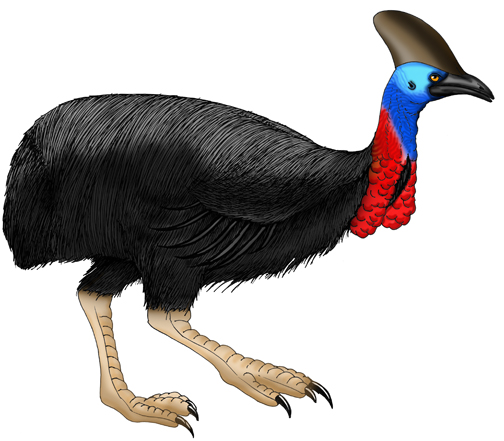
Cassowary (Southern)
Range
They are found in New Guinea, Northeastern Australia and on Islands of eastern Indonesia (Aru and Seram Islands).
Habitat
They live in open forests, grasslands and swamps in tropical and subtropical regions.
Body Traits
These big, flightless birds are covered in dark feathers that look like long hair. Each small wing has a half-dozen long spines instead of primary feathers. Their fleshy neck and head turns bright red and blue at about a year old. Two 7 inch (18 cm) long, bright red, fleshy wattles hang off the neck in adults. They have a large, boney head crest called a casque, that looks like horn and resembles a helmet. It is thought that they use this to push aside vegetation as they run through the underbrush. They have long, muscular, yellowish-brown legs. Their feet have long, sharp claws that they use to defend their territory or attack predators. Females are larger than males, reaching about 130 pounds (60 kg) and 5.5 feet (170 cm) long.
Habits
They live alone (solitary) and are very territorial using a deep, booming call to attract a mate. They can move very quickly on their long legs reaching speeds of up to 30 mph (50 km/hr). They can also jump. Though they are generally shy, hiding in the undergrowth, when threatened, they chase down the aggressor (or trespasser) and kick out with a clawed foot in an attempt to slice into them. Humans who live in their habitat or care for them in captivity report that they are a very dangerous animal and treat them with great caution and respect.
Diet
They eat fruit that has fallen to the ground, insects, mushrooms and small animals.
Reproduction
Females lay 4 bright green eggs in a nest made of plant matter on the ground. The male keeps the eggs warm (incubates) for up to 2 months. When the babies hatch, he cares for them for up to 9 months. Chicks are brown with vertical black stripes that may help camouflage them.
The female will go on to mate with another male and lay another clutch of eggs in another nest. She will do this up to 3 times every breeding season (which is in the winter when their food is abundant).
Classification
Kingdom: Animalia
Phylum: Chordata
Class: Aves
Order: Casuariiformes
Family: Casuariidae
Genus: Casuarius
Species: Casuarius casuarius
Current Subscribers: To view or print a PDF of this resource and its answer sheets (and link to any other available resources, like coloring, labeling, drawing pages and more), click the brown buttons at the top of this post. Note that these are only available to subscribers.
Not a Subscriber Yet?Join today to unlock these buttons and enjoy all of Exploring Nature’s resources.