

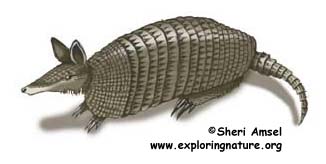
Dasypus novemcinctus
Range
They are found in the south central and southeastern U. S., south to Peru and Uruguay and on the islands of Granada, Trinidad and Tobado.Habitat
They live in thick bushy areas.Body Traits
They are a yellowish-brown color with almost no hair on their thick back, made of bands of horn and bone. There is some hair on their bellies. They can be up to 3.5 feet long including their tail. They have a long, pointed nose, and a very long, sticky tongue for catching insects. They have short legs and long claws for digging.Habits
They are active mostly at night (nocturnal). They dig burrow to sleep and hide in. They grunt when they are looking for food. When they are frightened they go into a burrow or thick brush or curl up the best they can (they cannot curl into a ball like other kinds of armadillos). They can swim.Diet
They eat insects — mostly beetles and ants, spiders and amphibians (frogs, toads and salamanders), but will eat fruits and plants.Predators
They can be eaten by jaguar, puma and coyote.Reproduction
Females are pregnant (gestation) for 4 months. In a large nest of grass and leaves, she has 4 babies that are exactly alike (they are from the same egg so are identical).Lifespan and/or Conservation Status
They live 12-15 years in the wild. They are not a threatened species.
Classification
- Kingdom: Animalia
- Phylum: Chordata
- Subphylum: Vertebrata
- Class: Mammalia
- Order: Cingulata
- Family: Dasypodidae
- Subfamily: Dasypodinae
- Genus: Dasypus
- Species: Dasypus novemcinctus