

Castor canadensis
Range
Beaver are found all over Canada and the U.S.Habitat
Beaver live on ponds and rivers in forests.Body Traits
They are the largest rodents in North America. Rodents are a family of mammals that gnaw (chew) with 2 pairs of sharp, front teeth (incisors). These incisors never stop growing so are always sharp. Beavers weigh from 40 – 100 pounds. They have a large, flat, scaly tail that they slap on the water when they are frightened. They have webbed back feet. They can close their throats while they carry sticks in the water so they won’t drown.Habits
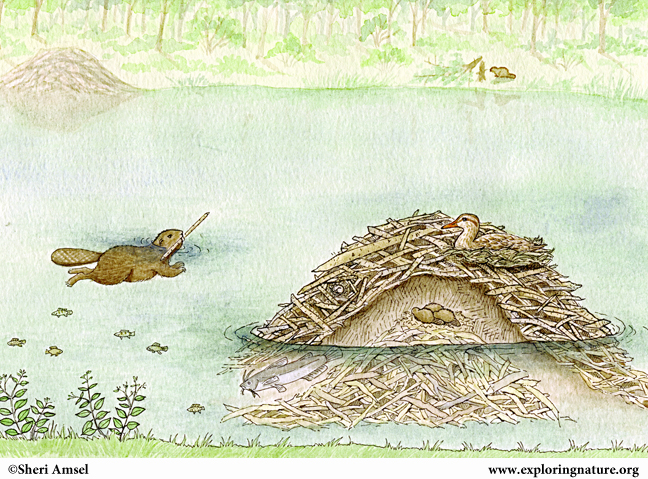
Beavers are active at night (nocturnal). They cut down trees to build dams. A dam blocks the flow of the river. The water level rises behind the dam. This makes a beaver pond where the beavers build their lodge. To protect their young, the only entrance is underwater.Diet
They eat water lilies roots, leaves and the green bark of softwood trees.Predators
Predators are lynx, wolverine, bear, coyote and even man.Reproduction
They have just one mate their whole life (monogamous). They both care for the babies. Females are pregnant for 4 months (gestation). She has up to 4 kits a year.Lifespan and/or Conservation Status
They live for about 10 years in the wild. At one time (late 1800s) they were almost extinct from over-hunting. Now they are plentiful. They are not a threatened species.
Classification
- Kingdom: Animalia
- Phylum: Chordata
- Subphylum: Vertebrata
- Class: Mammalia
- Order: Rodentia
- Suborder: Castorimorpha
- Family: Castoridae
- Genus: Castor
- Species: Castor canadensis