

Camelus bactrianus
Range
They are found in Northern Africa. They were introduced to Australia in 1840 and have thrived in Australia’s arid climate.Habitat
They live in the Sahara Desert in Northern Africa. They also live in Australia’s arid outback.Body Traits
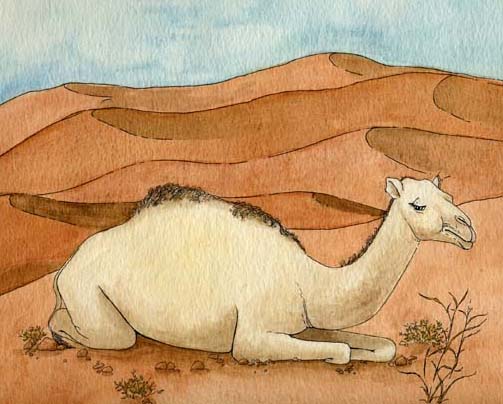
These one-humped, dromedary camels are mostly tame (domesticated) now. They are used for traveling in the desert. The camel’s hump is filled with fat. If they don’t have food for a long time the fat in their hump will begin to break down and be used by the body. Camels have a heavy fur coat that protects them from the heat. Their wide feet are made for walking on sand. They have thick eyelashes to protect their eyes from blowing sand. They also have thin, little nostrils to protect their nose from blowing sand. They weigh up to 1,500 pounds. They are 10 feet long.Habits
Camels can go for a long time without water. When they finally reach water they can drink a large amount at one time. They have thrived in Australia’s outback, where they now compete with native wildlife for water and food.Diet
They eat any plant in the desert. They also will eat fish, meat and bones. They can drink salty water if that is all there is. They can drink 1/3 of their body weight very quickly when they finally reach water.Predators
No known predators.Reproduction
Females are pregnant for 13 months (gestation). They have 1 calf.Lifespan and/or Conservation Status
They can live for 30 – 40 years. They are not a threatened species and in fact are raised as domestic animals.
Classification
- Kingdom: Animalia
- Phylum: Chordata
- Subphylum: Vertebrata
- Class: Mammalia
- Order: Artiodactyla
- Family: Camelidae
- Genus: Camelus
- Species: Camelus dromedarius