

Cervus elaphus
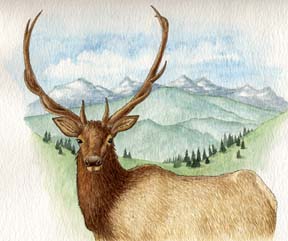
Range
American elk are found in the Rocky Mountains and Pacific Northwest of the United States and Canada.Habitat
Elk are found in many habitats, from deep forests and rocky slopes to alpine meadows and mountain ridges.Body Traits
They have a grayish coat with a lighter colored rear end. Males can weigh up to 1000 pounds, while the females only reach 600 pounds. Male elk grow large antlers that can weigh 30 pounds. They lose them in early spring after mating season.Habits
During mating season, in the fall, male elk “bugle.” Their bugle is a shrill call to round up their “harem” of females. They travel in herds of up to 25 elk.Diet
Elk eat grass, twigs and bark.Predators
Predators are mountain lions, wolves, coyotes, grizzly bears and man.Reproduction
Each female has 1 young in late May to early June. They are pregnant for 8.5 months (gestation).Lifespan and/or Conservation Status
They live up to 15 years in the wild. They are listed as Lower Risk – Least Concern.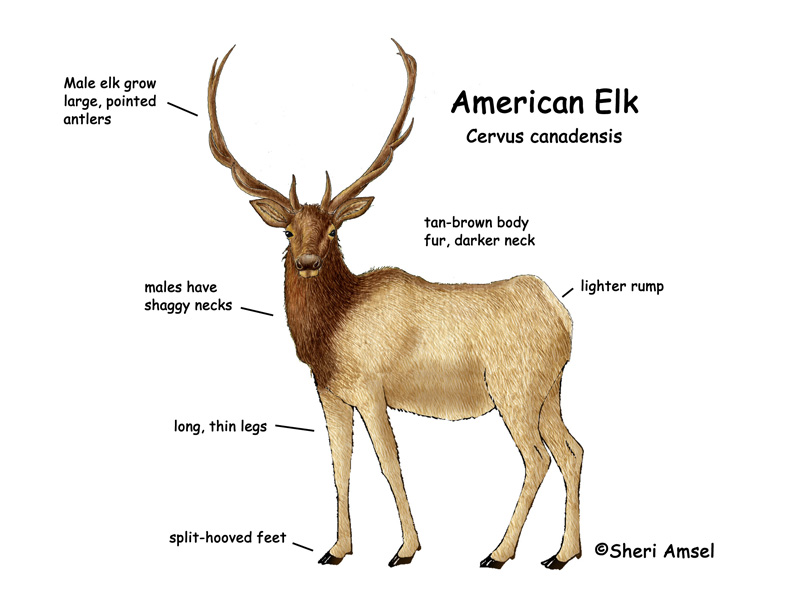
Classification
- Kingdom: Animalia
- Phylum: Chordata
- Subphylum: Vertebrata
- Class: Mammalia
- Order: Artiodactyla
- Family: Cervidae
- Subfamily: Cervinae
- Genus: Cervus
- Species: Cervus elaphus