

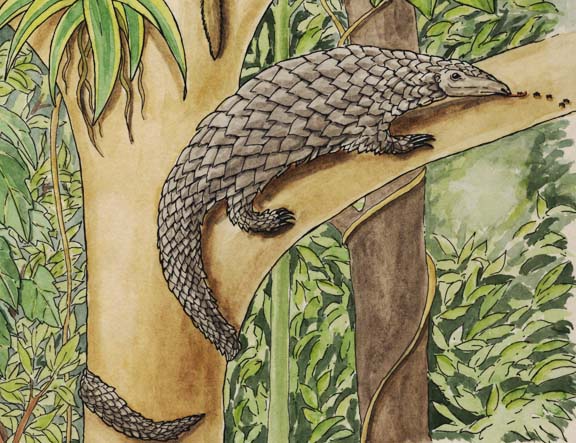
Manis tricuspis
Range
Pangolins are found in Africa. There are some species of pangolin in Asia as well.Habitat
Pangolins are found in rainforests, scrubland, and savannas.Body Traits
Pangolins are covered with large scales that, when they roll up into a ball, protects them from predators. They have long curved claws for breaking apart termite nests and a long sticky tongue that is 1.5 feet long, for catching ants and termites. Their long, wide tail can grip like a hand (prehensile). They have a small, pointed head with no teeth. Pangolins can grow to over 4 feet long, including their tails.Habits
They live alone except when coming together to mate or females with young. They are shy and active at night (nocturnal). They sleep days in their burrow. They are good climbers and swimmers.Diet
They eat termites.Predators
Predators are leopards, hyenas, pythons and man.Reproduction
Females are pregnant for about 4.5 months (gestation) and have a single baby at any time of year.Lifespan and/or Conservation Status
Their lifespan is not known, but they have lived more than 10 years in captivity. They are listed as Lower Risk – least concern.
Classification
- Kingdom: Animalia
- Phylum: Chordata
- Subphylum: Vertebrata
- Class: Mammalia
- Order: Pholidota
- Family: Manidae
- Genus: Manis
- Species: Manis tricuspis