

Antilocapra americana
Range
Pronghorn antelopes are found only in one place in the whole world — the American west.Habitat
They live out on the grasslands, liking the shorter grass prairies where they can use their excellent vision to watch for predators. They are also found in dry (arid) scrublands.Body Traits
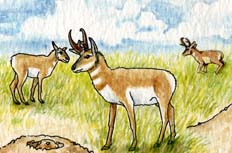
They are tan to brown colored with a lighter belly and rump and light tan rings around their necks. Both males and females have horns (the females are much smaller). Horns are different than the antlers of deer and moose. Pronghorns are the only animals in the world who lose their horns every year. The outer covering (sheath) of the horn falls off every fall and then grows back by the next summer. Males can grow to weigh more than 150 pounds. Females rarely weigh more than 100 pounds.Habits
Pronghorns are considered the fastest animal in the whole western hemisphere reaching speeds of 60 mph.Diet
Pronghorns are herbivores, eating mostly plants, shrubs (like sagebrush) and some cactus and grass.Predators
Predators include coyote, grizzly (in Yellowstone Park), and man.Reproduction
In the fall, territorial males compete for females to mate with, sometimes fighting aggressively. Winning males collect harems of many females (does). Females are pregnant for about 8.5 months (gestation) having 1-2 young in late May to early June. Pronghorn antelopes have twins a little more than they have single babies.Lifespan and/or Conservation Status
They can live 7 to 10 years in the wild. They are listed as Lower Risk – least concern.
Classification
- Kingdom: Animalia
- Phylum: Chordata
- Subphylum: Vertebrata
- Class: Mammalia
- Order: Artiodactyla
- Family: Antilocapridae
- Genus: Antilocapra
- Species: Antilocapra americana