

Bradypus tridactylus
Range
Three-toed sloths are found from Central America (in Honduras) to the middle of South America (Northern Argentina).Habitat
They live in tropical rainforests from river valleys to the mountains.Body Traits
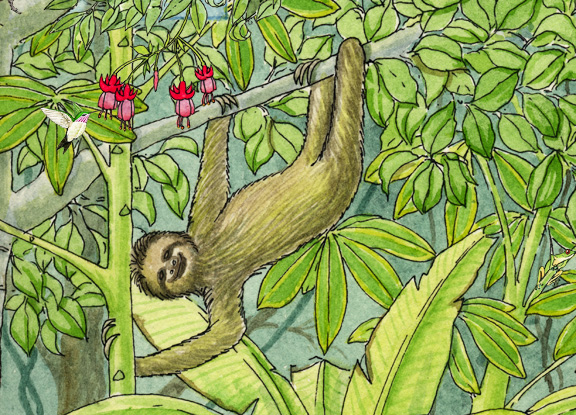
There are many species of three-toed sloth. The most common is the brown-throated, three-toed sloth. They weigh about 10 pounds and are almost tailless, with flat faces, a dark eye mask and invisible ears. The air is so hot and humid that they grow green algae in their shaggy, grooved fur, which helps them blend in (camouflage). Their very slow movement also helps them to hide. They have a complex stomach with many parts to digest the rough leaves they eat and get out the nutrients. It takes a long time for them to digest their food (up to a month!).Habits
Sloths are excellent climbers and swimmers, but cannot walk. They live alone (solitary) except to mate, high up in the trees (arboreal). They rarely ever come to the forest floor because they are built for climbing and cannot escape predators on the ground. They sleep up to 20 hours a day.Diet
They have long, curved claws and hang upside down while they feed on the leaves of the cecropia tree.Predators
Predators include jaguars, harpy eagles and anacondas.Reproduction
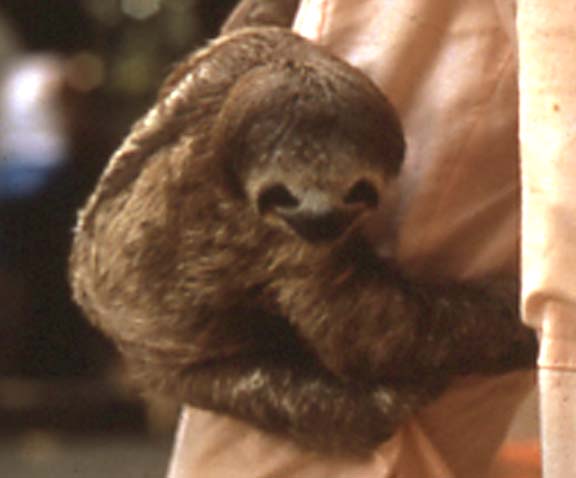
They breed all year. Females are pregnant for 6 months (gestation) and have 1 baby. A sloth baby clings to the belly of its mother for the first six months of its life. Then it begins to move off for a time and feed on its own.Lifespan and/or Conservation Status
They can live up to 12 years in the wild. They are listed as Lower Risk – least concern.
Classification
- Kingdom: Animalia
- Phylum: Chordata
- Subphylum: Vertebrata
- Class: Mammalia
- Order: Pilosa
- Suborder: Folivora
- Family: Bradypodidae
- Genus: Bradypus
- Species: Bradypus tridactylus