

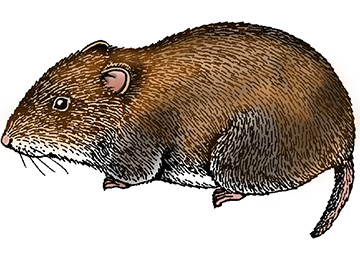
Microtus pennsylvanicus
Range
Meadow voles are found throughout most of Canada and Alaska, south through the northern half of U.S. and south down to Georgia.Habitat
They live in grassy fields, woodland, orchards, marshes, and along lakes and rivers.Body Traits
Meadow voles are 5-7 inches long, including their tail and weigh about 1-2 ounces. They vary in color from yellowish, reddish to blackish-brown.Habits
They build tunnels (runways) under the grass where they can travel safely from predators. They are active at night (nocturnal) in summer, and during the day (diurnal) in winter. They do not hibernate.Diet
Meadow voles eat grass, seeds, leaves, roots, flowers, bark, bulbs, and insects.Predators
They in turn are an important source of food for many predators, including hawks, owls, foxes, snakes, raccoons, etc.Reproduction
Females are pregnant for 3 weeks (gestation) having 1-9 babies. They commonly have 5 litters a year.Lifespan and/or Conservation Status
Meadow Voles live 1.5 years in the wild. They are listed as Lower Risk – least concern.
Classification
- Kingdom: Animalia
- Phylum: Chordata
- Subphylum: Vertebrata
- Class: Mammalia
- Order: Rodentia
- Suborder: Myomorpha
- Family: Cricetidae
- Subfamily: Arvicolinae
- Genus: Microtus
- Species: Microtus pennsylvanicus