

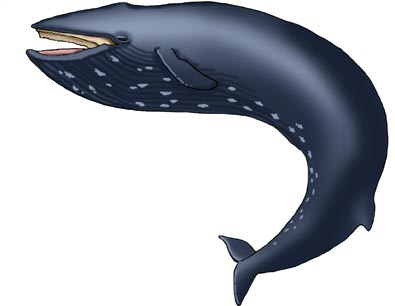
Balaenoptera musculus
Range
Blue whales are found in all the oceans of the world.Habitat
They spend the winters in temperate and subtropical areas, then they migrate to the polar regions in the spring and summer.Body Traits
The blue whale is the largest animal in the world. They measure between 70-100 feet long and weigh as much as 150 tons (300,000 pounds). Their heart alone can weigh 2,000 pounds. Blue whales do not have teeth. They are baleen whales. This means that they have up to 400 stiff, baleen plates that hang from their upper jaws that act as a filter.Habits
Blue whales swim 14 mph and can go faster. They can dive to deeper than 1,000 feet, but feed in less than 30 feet of water. They can stay underwater from 10 – 20 minutes. They travel alone or in small groups.Diet
The whale gulps in a giant mouthful of water and krill (a tiny shrimp-like animal) and presses their huge tongue against the plates pushing out all the water and keeping the krill. They do this over and over and in this way blue whales eat as much as 4 tons (8,000 pounds) of krill a day.Predators
Their only real predator is man.Reproduction
Females are pregnant for 12 months (gestation) and have 1 calf. They will not have another for 2-3 years.Lifespan and/or Conservation Status
The blue whale is thought to be able to live 80 years. They are listed as endangered.Related Links
Coloring Page Labeling Page Download Hi-Res B&W Diagram Download Hi-Res In-Habitat Poster Download Hi-Res Color Diagram


Classification
- Kingdom: Animalia
- Phylum: Chordata
- Subphylum: Vertebrata
- Class: Mammalia
- Order: Cetacea
- Suborder: Mysticeti
- Family: Balaenopteridae
- Genus: Balaenoptera
- Species: Balaenoptera musculus