

Canis lupus

Range
The timber wolf is found in Canada and Alaska and the northern United States in the Rocky Mountains, western Great Lakes, and the northeast.
Habitat
Wolves are found on open prairies, in forests and mountainous regions.
Body Traits
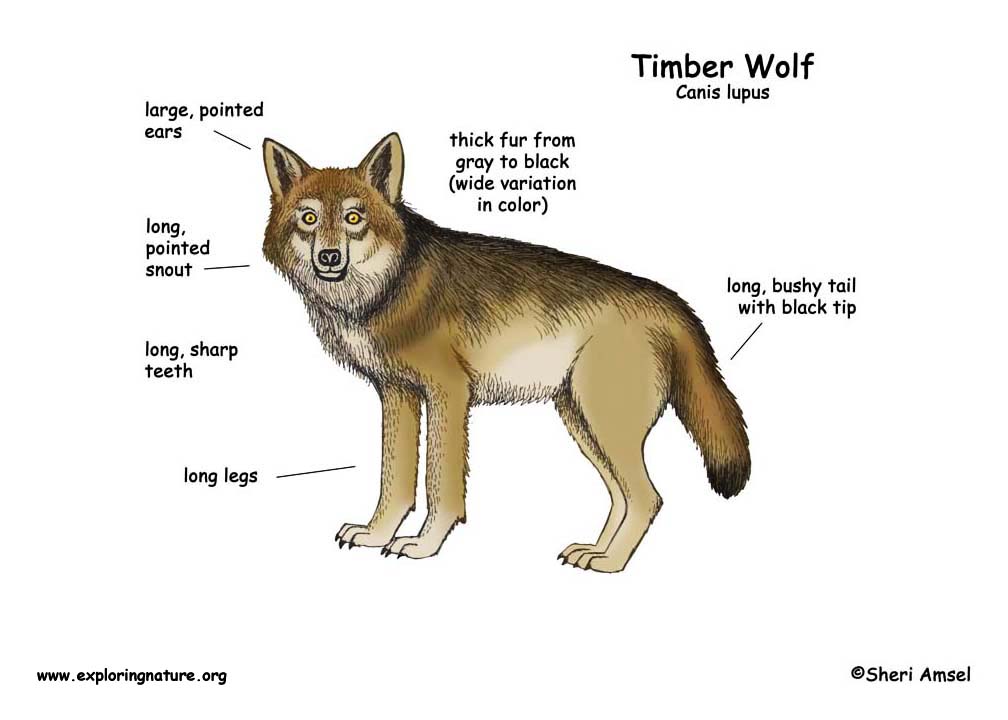
Timber wolves, also called gray wolves, are the largest wild members of the dog family. Males are larger than females. They can grow to 5.5 feet (164 cm) long, including the tail, and weigh from 70 to over 100 pounds (45 kg). Timber wolves vary in color from silvery-brown to yellowish-gray. They have white bellies and bushy tails.
Habits
Wolves are territorial and defend the area where they hunt and den. They can run up to 25 mph for short distances when chasing prey but usually trot at about 5 mph and can travel 10–30 miles looking for food. Wolves live in a pack, which is a family group made up of one pair of adults and their young, including those from past years.
Diet
Most of their diet consists of white-tailed deer (80%). They also eat beaver, moose, fish, muskrat, and rabbits.
Predators
Their only real predator is humans.
Reproduction
Only the lead (alpha) female in a pack breeds each year. After a 9-week pregnancy, she gives birth to about six pups in February in an underground den. By fall, the pups are large enough to hunt with the pack.
Lifespan and Conservation Status
Timber wolves can live up to 17 years in the wild. They are listed as vulnerable on the CITES list (International) and endangered on the U.S. Federal Endangered Species List.
Classification
- Kingdom: Animalia
- Phylum: Chordata
- Subphylum: Vertebrata
- Class: Mammalia
- Order: Carnivora
- Suborder: Caniformia
- Family: Canidae
- Genus: Canis
- Species: Canis lupus