

Enhydra lutris
Range
Sea otters are found in North America in Washington and California and in Russia and Japan.Habitat
They live in shallow coastal waters, often floating in kelp forests and using kelp strands as anchors to keep themselves from floating off in the current.Body Traits
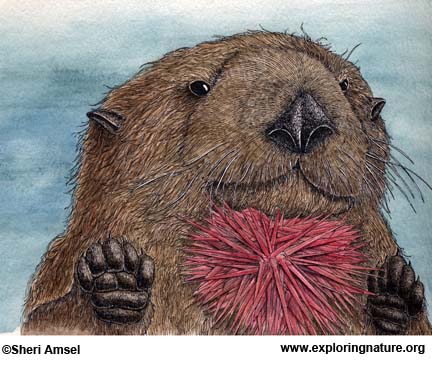
They have the thickest fur of any animal. This is important because sea otters do not have the layer of blubber to keep them warm, as do other marine mammals. The sea otter is the largest member of the weasel family reaching 4 feet in length and weighing between 50 – 100 pounds. Males are larger than females and the northern species of sea otter is large than the southern species. The sea otter is what is called a “keystone species.” This means that as long as the sea otter is present it keeps the other parts of its ecosystem in balance. By feeding on sea urchins, sea otters protect the abalone population. By feeding on shellfish they protect the kelp forests. When sea otters disappear the ecosystem is affected.Habits
They use rocks to pry shellfish off the seabed and hammer them open, making them the only mammals other than primates (monkeys and apes) who use tools.Diet
Sea otters eat sea urchins, abalone, mussels, clams, crabs, and snails. Sea otters can dive over 300 feet looking for food.Predators
Predators are killer whales, sharks and humans.Reproduction
Sea otters breed all year. Females are pregnant for 6-8 months (gestation), having 1 pup.Lifespan and/or Conservation Status
They live up to 20 years in the wild (Females usually live 5-10 years longer than males). Sea otters are listed as “threatened.” They are listed as endangered on the CITES List (International List) and threatened on the U.S. Federal Endangered Species List.
Classification
- Kingdom: Animalia
- Phylum: Chordata
- Subphylum: Vertebrata
- Class: Mammalia
- Order: Carnivora
- Suborder: Caniformia
- Family: Mustelidae
- Subfamily: Lutrinae
- Genus: Enhydra
- Species: Enhydra lutris