

Vormela peregusna
Range
They are found in Europe, Russia, Siberia, China, Bulgaria, Romania, Asia Minor, the Middle East, Pakistan, Yugoslavia, Mongolia, and Egypt.Habitat
They live in open, dry, rocky country. They can be found in semi-desert, low hills, scrub forest and steppes but not usually mountainous areas. They have adapted to life in farming areas.Body Traits
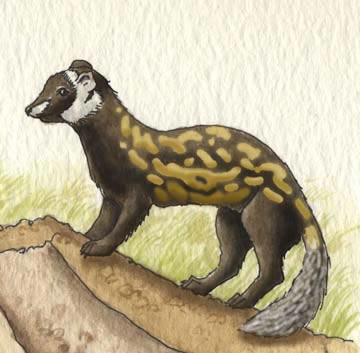
They have long thin bodies with short legs and sharp claws. They have a long fluffy tail. They have brown and yellow mottled spots all over their back and a yellow band around their tail. Their faces are dark with a white muzzle and a white band above the eyes and on the tops of the ears, which are large.Habits
They live alone except to mate. If they feel threatened they will hiss and shriek, baring their teeth. They also release a bad smell, like others in their family (skunk and weasel). They are great diggers.Diet
They eat small mammals (like mice and squirrels), birds, lizards, frogs, insects and plants and fruit (omnivores).Predators
Man in their main hunter, though they can be taken by foxes or wild cats.Reproduction
Like many of the animals in their family (mustelids), marbled polecats have “delayed implantation.” That means that even though they all mate in the spring, they deliver their young at different time, depending on how the weather and food conditions are. They have up to 8 cubs.Lifespan and/or Conservation Status
Unknown.
Classification
- Kingdom: Animalia
- Phylum: Chordata
- Class: Mammalia
- Order: Carnivora
- Family: Mustelidae
- Subfamily: Mustelinae
- Genus: Vormela
- Species: Vormela peregusna