

Bos grunniens
Range
They are found on the Tibetan plateau, in Mongolia and throughout the Himalayas in Asia.Habitat
They live in high altitude (up to 18,000 feet) grassy areas, treeless, mountainous regions and dry steppes.Body Traits
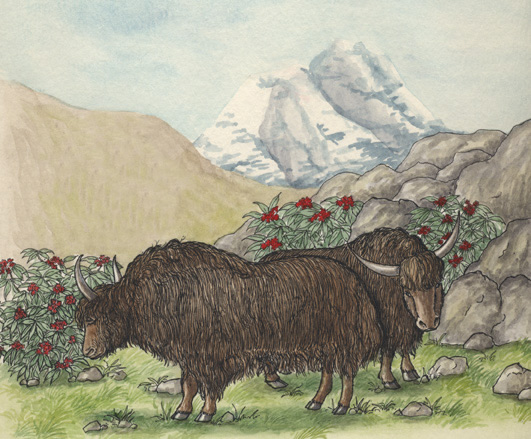
They are large animals, the males reaching more than a ton (2,200 pounds or 1,000 kg). Males are 3 times the size of females. They have large, humped shoulders, short legs and tend to hang their large heads. The curved horns on the males can reach more than 3 feet long. They are smaller on females. Their long, shaggy coats almost reach the ground and are thick enough to keep them warm in the frigid temperatures of the Tibetan plateau. Their feet have wide hooves for walking in deep snow.Habits
Males usually live alone, while females will form herds. They will travel a long way in search of food.Diet
They eat grass, moss and lichens (herbivores).Predators
They can fall prey to wolves or snow leopards.Reproduction
Females are pregnant for 9 months (gestation) and have 1 calf. They only breed every other year. Males compete for access to the females.Lifespan and/or Conservation Status
They can live for 25 years in the wild. They are listed as vulnerable on the CITES List (International List) and endangered on the U.S. Federal Endangered Species List.
Classification
- Kingdom: Animalia
- Phylum: Chordata
- Subphylum: Vertebrata
- Class: Mammalia
- Order: Artiodactyla
- Family: Bovidae
- Subfamily: Bovinae
- Genus: Bos
- Species: Bos grunniens