

Myotis lucifugus
Range
They are found from southern Canada and Alaska, south into the U.S. and in some of the forested mountain regions of Mexico. They are not seen in the extreme southeastern portions of the U.S.Habitat
They are found in most habitats, including populated areas where they roost in attics, outbuildings and woodpiles. In the wild, they seem to prefer forested areas near a water source.Body Traits
They are tiny bats with small ears. Their shiny fur can be a wide range of shades from tan to dark brown and is lighter underneath. They are up to 4” long, weigh less than ½ ounce and have a wingspan of up to 10”. There is a flap of skin that stretched between the legs and tail called the uropatagium.Habits
They are nocturnal, coming out at night to hunt, using echolocation. Echolocation is a kind of radar that uses the bat’s high-pitched calls to bounce off objects. They can actually “see” what is around them by how their calls bounce off their surroundings. During the day they sleep (roost) in groups in the furrowed bark of trees, under porches, bridges and in rock cracks. They can squeeze in very small spaces. They hibernate huddled in big groups in winter when there is no insect prey.Diet
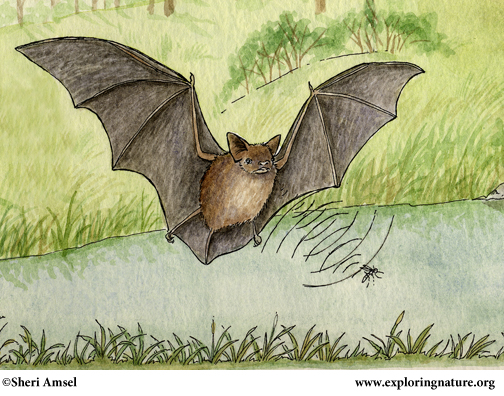
They eat insects – mostly aquatic insects that they catch while gliding over the water after darkPredators
They are preyed upon by birds of prey, like hawks and owls, by raccoons, weasels, and even house cats.Reproduction
They mate in the fall, but females store the sperm until spring when they become pregnant for about 3 months (gestation). They give birth upright, catching their single pup in the flap of skin that stretches between their legs and tail. They can fly by 3 weeks old and are on their own by a month old.Lifespan and/or Conservation Status
Can live more than 10 years in the wild, but usually less. They are not a threatened species.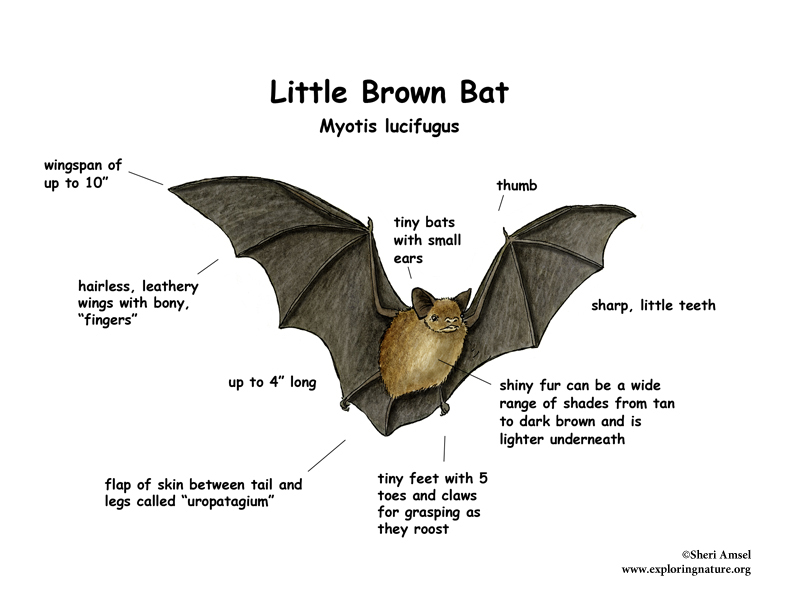
Classification
- Kingdom: Animalia
- Phylum: Chordata
- Subphylum: Vertebrata
- Class: Mammalia
- Order: Chiroptera
- Family: Vespertilionidae
- Subfamily: Myotinae
- Genus: Myotis
- Species: Myotis lucifugus