

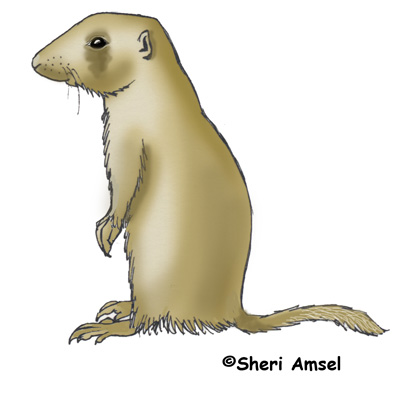
Cynomys leucurus
Range
They are found most commonly in the grassland region of Wyoming, but can be found on some areas in Colorado, Utah, and Montana.Habitat
They live on dry (arid) grasslands and shrubby area.Body Traits
They reach 15.5” long and weigh up to 3 pounds. They have small, rounded ears. They are tan to light brown with a dark cheek patch and eyebrow and large eyes. Their tail is lighter than their body and covered with white hairs.Habits
They are active during the day (diurnal). They hibernate through much of the year starting as early as late-August (though more commonly by early October) through March.Diet
They eat grass, plants and shrubs.Predators
They are eaten by badgers, coyote, foxes, bobcats, golden eagles, hawks, and rattlesnakes.Reproduction
They mate late in March when they wake from hibernation. Females are pregnant for about a month (gestation). They have up to 8 young, though usually about 5. They have only one litter per year.Lifespan and/or Conservation Status
They live up to 5 years in the wild, but die within their first year. They are listed as Lower Risk – least concern.
Classification
- Kingdom: Animalia
- Phylum: Chordata
- Subphylum: Vertebrata
- Class: Mammalia
- Order: Rodentia
- Suborder: Sciuromorpha
- Family: Sciuridae
- Subfamily: Xerinae
- Genus: Cynomys
- Species: Cynomys leucurus