

Ovis canadensis
Range
They are found in southwestern Canada south through the western U.S. and Rocky Mountain region to northern Mexico. They can be found in dry, rugged areas of Texas west to California.
Habitat
They live in the mountains in rocky, dry terrain and high desert.
Body Traits
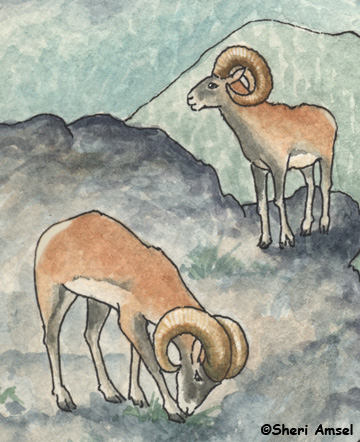
They are brown with a lighter rump and tip of the nose. They have large, ridged, horns that curve around by the face. Both sexes have horns, though in males they grow much larger. Unlike antlers, horns are not shed yearly. They keep them throughout their lives and they keep growing from year to year. Males are larger than females in general and can reach 6 feet long and 300 pounds. They have hooved feet with thick pads made for traveling in rocky places.
Habits
They are active during the day (diurnal) and travel in big herds.
Diet
They eat grass and shrubs.
Predators
They are killed by mountain lions, wolves, and man.
Reproduction
Males compete for females by ramming heads with smashing blows. Females are pregnant for 6 months (gestation) and have 1 kid.
Lifespan and/or Conservation Status
They can live more than 20 years, but usually less. They are listed as Lower Risk – conservation dependent.

Classification
- Kingdom: Animalia
- Phylum: Chordata
- Subphylum: Vertebrata
- Class: Mammalia
- Order: Artiodactyla
- Family: Bovidae
- Subfamily: Caprinae
- Genus: Ovis
- Species: Ovis canadensis