

Marmota flaviventris
Range
They are found in the western United States and up throughout the Rocky Mountains into Southwestern Canada.Habitat
They live in high, rocky, open places (at 6,0000 ft and higher) with open grassy areas where they feed and often on the edge of the forests.Body Traits
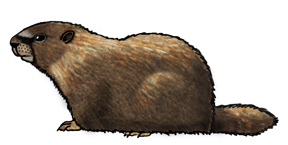
They are rodents in the squirrel family, weighing up to 10 pounds. They are more than 2 ft long with an 8-inch tail and are covered in hair. Males are larger than females. Their fur is golden on their shoulders and belly. The darker fur on their backs is frost-tipped. Lighter patch on the nose, between their eyes.Habits
They are active during the day (diurnal). They are true hibernators and sleep from September through May at high elevations (shorter at lower elevations). They live in groups called harems with one male and several females and their young. Many harems may live near each other in a colony.Diet
They eat leaves, grasses, fruits, seeds and flowers of plants. They also sometimes will eat insects and eggs. They are omnivores.Predators
They are hunted by foxes, coyotes and in their northern range – wolves.Reproduction
Females are pregnant for a month (gestation). They have 3-5 kits in their burrows. They breed once a year after waking from winter sleep.Lifespan and/or Conservation Status
They can live up to 15 years in the wild. They are not a threatened species.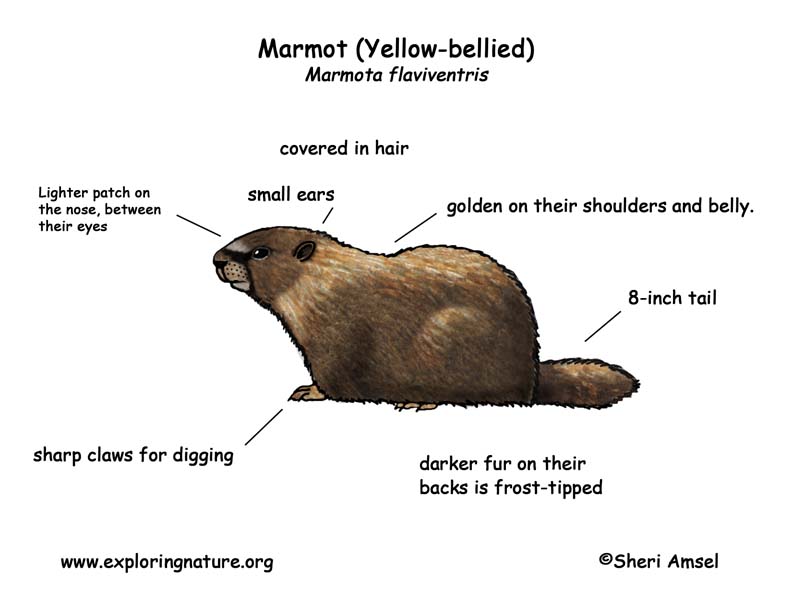
Classification
- Kingdom: Animalia
- Phylum: Chordata
- Subphylum: Vertebrata
- Class: Mammalia
- Order: Rodentia
- Suborder: Sciuromorpha
- Family: Sciuridae
- Subfamily: Xerinae
- Genus: Marmota
- Species: Marmota flaviventris