

Nasua nasua
Range
They are found in South America in Columbia, Ecuador, Venezuela, Uruguay, and Argentina.Habitat
They live in forests at higher elevations – over 8,000 feet (2,400 m) in the Andes and in rainforest habitats.Body Traits
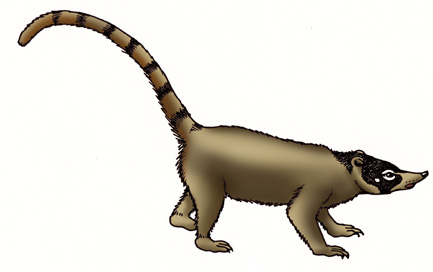
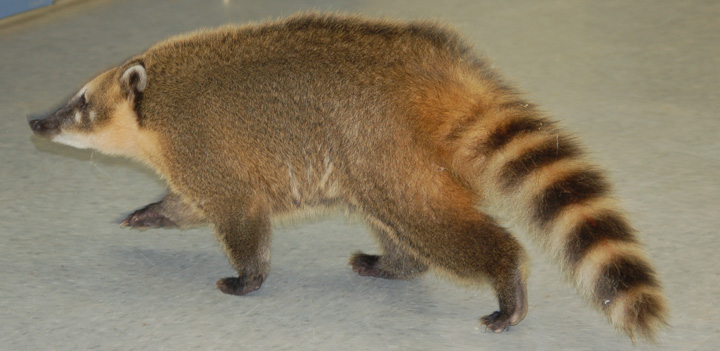
They are gray to rusty brown on top and white below. They have a long, slender head and snout with a turned up nose. The snout is brown with light spots around the eyes. They have small ears with fringes of white fur inside the rims. Their very long tail is brown with lighter stripes. They have long, sharp claws for digging and climbing and can rotate their back feet for climbing down head first. They reach up to about 4.5 feet long (137 cm) with more than half of that being tail. They can weigh up to 13 pounds (6 kg).Habits
They are active during the day (diurnal). They spend much of their time of the ground, but are good climbers and sleep, mate and give birth in the trees. They are in the same family as raccoons, and like raccoons, may seek out human crops, garbage and poultry as a source of food.Diet
They are omnivores, eating fruit and leaves, insects, spiders, scorpions, rodents, lizards, eggs and even dead animals (carrion).Predators
They are preyed on by hawks, mountain lions, ocelots, jaguars, jaguarundis, and boa constrictors.Reproduction
Females live in small groups of up to 30 including young. During breeding season, one male joins the group and fathers all their offspring (polygamous). The rest of the year males live alone (solitary). Females will go off to tree nests for several weeks to have their young and nurse them. They are pregnant for about 11 weeks (gestation) and have up to 7 babies born in a tree nest in the spring. They nurse for 4 months. About 1.5 months after the young are born, they begin to walk and climb. At this time, the females will bring them to join the band.Lifespan and/or Conservation Status
They live up to 8 years in the wild and much longer in captivity. They are listed as Lower Risk – Least Concern on the IUCN Red List.
Classification
- Kingdom: Animalia
- Phylum: Chordata
- Subphylum: Vertebrata
- Class: Mammalia
- Order: Carnivora
- Suborder: Caniformia
- Family: Procyonidae
- Genus: Nasua
- Species: N. nasua