

Condylura cristata
Range
They are found in eastern Canada and the U.S. south to about Georgia and west to Manitoba and the Dakotas.Habitat
They live in habitats with moist soil. This can be in forests, wetlands, meadows or scrubby areas as long as poor drainage keeps the soil moist.Body Traits
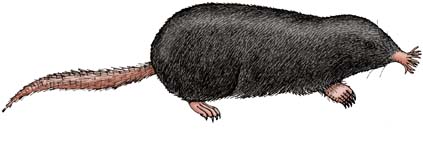
Star-nosed moles are about 4.5 inches long and are covered with dark fur except on their feet and snout. Their front feet are large and clawed for digging. The tail is up to 3.25 inches long (8.5 cm) and is scaly, ringed and covered in rough hairs.The tail is fatter in winter because the moles stores fat there that will give the mole energy for spring breeding. They have a ring of 22 tiny, fleshy tentacles (11 pairs), called rays, around the tip of the nose in a star pattern. Each ray has tiny sense organs called Elmer’s organs. These sensitive rays are used to find food in the ground. They have small eyes and no visible ears (they do have ears though and very good hearing).Habits
They dig shallow tunnels in the soil pushing out the excess soil to form molehills above ground. They can swim and may have tunnels that empty out underwater into a pond or wetland.Diet
They eat earthworms, insects, spiders, small amphibians and fish.Predators
They are eaten by hawks, owls, weasels, minks and fishers.Reproduction
The females are pregnant for 6.5 weeks (gestation) and give birth to a litter of up to 7 tiny, hairless young in the spring. Pairs will are monogamous for the length of the breeding season.Lifespan and/or Conservation Status
They can live for up to 4 years in the wild, but usually less.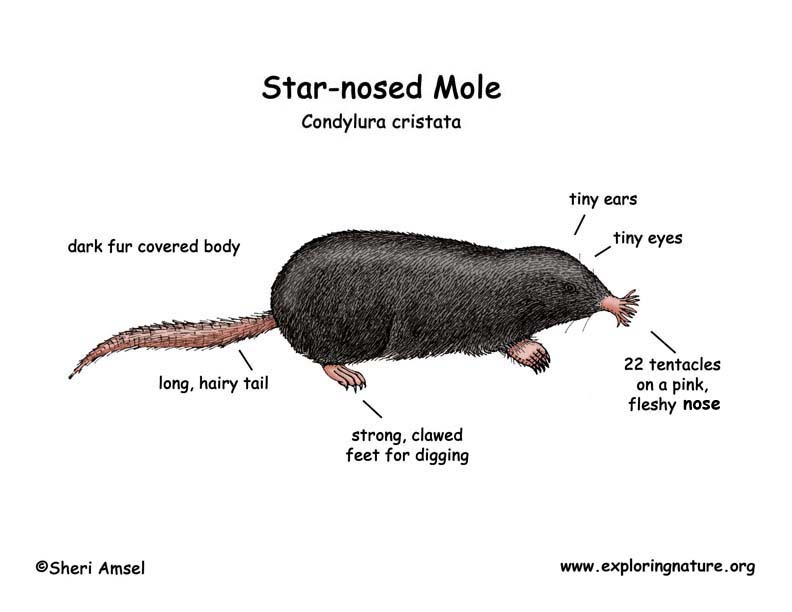
Classification
- Kingdom: Animalia
- Phylum: Chordata
- Class: Mammalia
- Order: Soricomorpha
- Family: Talpidae
- Subfamily: Scalopinae
- Genus: Condylura
- Species: C. cristata