

Macrotis lagotis

Range
They are found in Australia, specifically in western Australia and the Northern Territory and southwest Queensland.Habitat
They live in dry tussock grass areas and shrub lands with acacia.Body Traits
They are almost 2 feet long with long, thin hind legs like a kangaroo. They have a pouch where they carry young (marsupials). They have a soft fur coat that is gray colored with a lighter belly. They have big, hairless ears and a long, pointed snout. Their foot long tail has a black band around the middle. They hold it out straight when they run. They have sharp claws for digging burrows.Habits
They are active at night (nocturnal). During the day they rest in deep burrows. They live alone except to mate.Diet
They eat seeds, bulbs, fruit, fungi, and insects.Predators
They are hunted by dingoes, cats, foxes, and birds of prey.Reproduction
Females are pregnant for about 3 weeks (gestation) and have up to 2 young. They live in the female’s pouch for another 3 months, nursing.Lifespan and/or Conservation Status
They live up to 3 years in the wild. They are listed as a “vulnerable” species.Related Links
Coloring Page Labeling Page B & W and Color Body Diagrams, Plus a Habitat Poster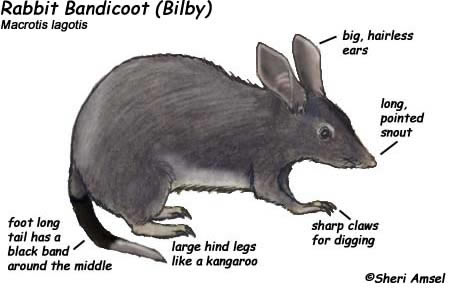
Classification
- Kingdom: Animalia
- Phylum: Chordata
- Subphylum: Vertebrata
- Class: Mammalia
- Order: Peramelemorphia
- Family: Thylacomyidae
- Genus: Macrotis
- Species: Macrotis lagotis