

Tadarida brasiliensis
Range
They are found throughout the southern U.S. (especially in the southwest), in Mexico, Central America and southwestern South America.
Habitat
They roost in caves, buildings and under bridges.
Body Traits
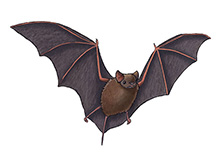
They can reach up to 4” long and weigh up to only .5 oz. The “free” part of their tail extends beyond the flap of skin between their legs and tail (which is called the uropatagium). Their wingspan is about 11” across. They have large ears and a short snout.
Habits
They are nocturnal, hunting at night using echolocation. Echolocation is a kind of radar that uses the bat’s high pitched calls to bounce off objects. They can actually “see” what is around them by how their calls bounce off their surroundings. They are strong flyers and climbers. They live in large colonies and are thought to be very social bats, calling and interacting in their roost. Because their colonies are large, they often spread over a larger area to feed at night than other bat species. They migrate south in the fall and return north in spring to raise their young and feed on emerging insects.
Diet
They use echolocation to find prey. They eat insects (insectivorous) – mostly moths, but will also eat ants, flies, beetles, dragonflies, etc.
Predators
Predators include hawks, owls, raccoons, snakes and opossums.
Reproduction
Females are pregnant for 3 months (gestation). They have one pup in June. They are dependent on their mother for care and nursing for 1- 2 months. Females will form group of pups (called a creche), so they can leave them to feed. They find their pups to nurse by smell and call. They have just 1 pup a year.
Lifespan and/or Conservation Status
They can live up to 10 years in the wild, but most live a much shorter time. They are exposed to pesticides because of their insect consumption, which can build up in their systems and cause a population decline. Roosting habitat disturbances can also affect populations.

Classification
Kingdom: Animalia Phylum: Chordata Subphylum: Vertebrata Class: Mammalia Order: Chiroptera Family: Molossidae Genus: Tadarida Species: Tadarida brasiliensis