

Helarctos malayanus
Range
They are found in Asia from the Himalayas to China, Burma, Indochina and the Malayan peninsula.Habitat
They live in dense, tropical rainforests.Body Traits
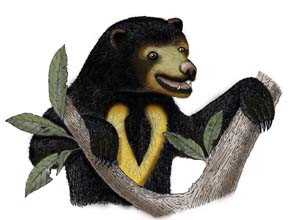
They are the smallest bear, weighing only up to 150 pound (64 kg) and reaching 4 feet long. Females are slightly smaller. They are all black with a yellowish snout and u-shaped blaze on the chest. They have small ears and a wide, flat head. They have large paws with long, curved claws. Their limbs turn in, giving them a seemingly “pigeon-toed” walk. They have long flexible tongues that they can use to fish out termites or honey from hives.Habits
They can climb trees (arboreal) and are often found in them sleeping or basking in the sun. They are active at night (nocturnal). They do not hibernate.Diet
They are omnivores, eating insects ¬– like bees, ants and termites, fruits, honey, eggs, small animals (lizards, rodents and birds), and even dead animals (carrion).Predators
Cubs may be killed by tigers, but adults have few predators except humans.Reproduction
Females are pregnant for about 3 months (gestation) and have 1-3 young. Like other bear species, sun bears may experience delayed implantation where they mate but do not become pregnant until later, so births are timed with better food abundance or climate. The cubs stay with their mother for up to 3 years before going out on their own.Lifespan and/or Conservation Status
They can live for about 25 years. Their numbers are declining from hunting and habitat destruction.
Classification
- Kingdom: Animalia
- Phylum: Chordata
- Subphylum: Vertebrata
- Class: Mammalia
- Order: Carnivora
- Suborder: Caniformia
- Family: Ursidae
- Genus: Helarctos
- Species: H. malayanus